NASA(미국항공우주국)
기관별 자료
40건
255: 413270 UFO's and Defense What Should we Prepare For
This file contains an independent report on UFOs written by the French association COMETA (previously published in the French magazine VDS in 1999), which details the results of a study by the Institute of Higher Studies for National Defence. The file also includes a letter from Carol Rosin in which she notes that she was spokesperson for von Braun during the last years of his life.
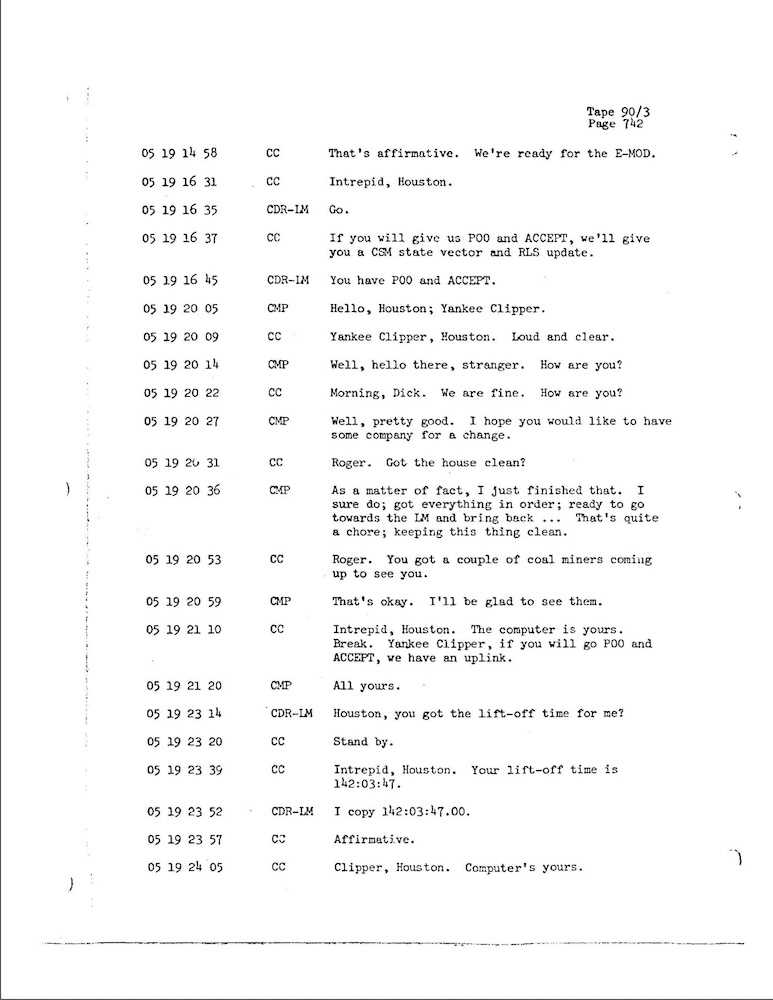
NASA-UAP-D001, Apollo 12 Transcript, 1969
Apollo 12 was the fourth crewed U.S. mission to the Moon and the second to land astronauts on the lunar surface. This document is an excerpt from the Apollo 12 Technical Air-to-Ground Voice Transcription, November 1969, highlighting two periods in which astronauts reported observing unidentified phenomenon: a one hour period on the fifth day, and a two minute period on the sixth day. These transcripts contain contemporaneous observations by the flight crew reacting to unidentified phenomenon. • Day 05, Hour 19, Minute 14, Second 58 through Day 05, Hour 20, Minute 12, Second 14: o At 05:19:27:25, the pilot of the Lunar Module (LMP-LM), Astronaut Alan L. Bean, described observing particles and flashes of light “sailing off in space” via the onboard Alignment Optical Telescope (AOT). He characterized these phenomenon as “escaping the Moon.” • Day 06, Hour 00, Minute 21, Second 42 through Day 06, Hour 00, Minute 23, Second 33: o Mission Commander, Charles “Pete” Conrad, described observing floating debris outside the lunar module, which had been illuminated by the module’s onboard tracking light. At 06:00:21:51, Conrad assessed that the tracking light had burnt out because he could no longer see the debris from the module.
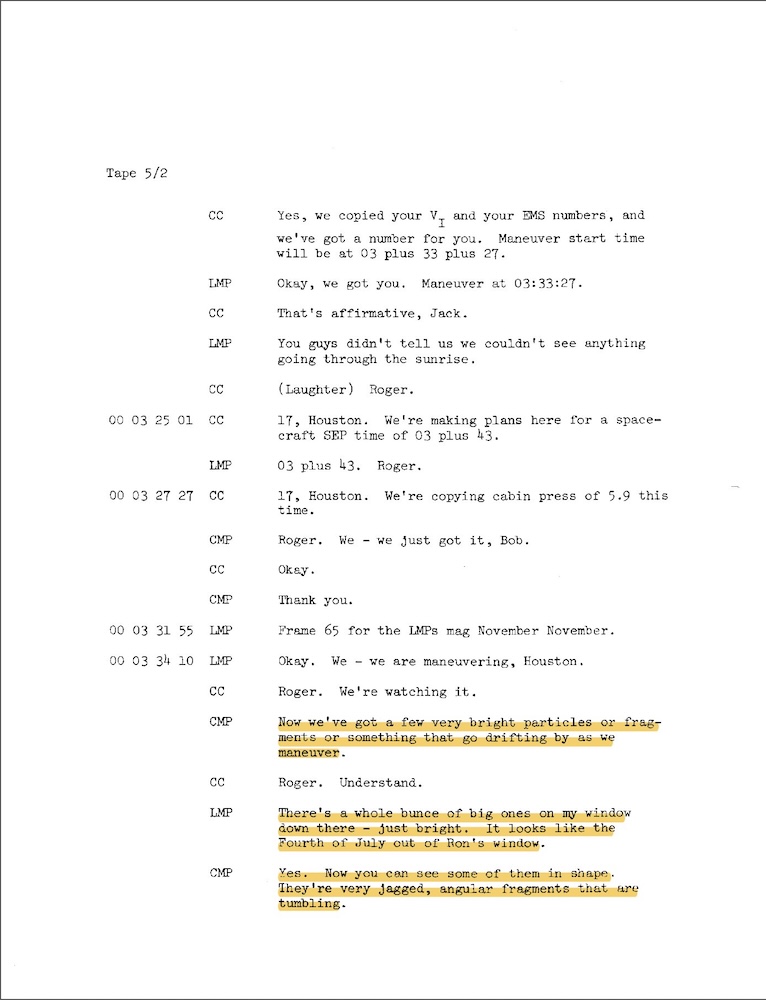
NASA-UAP-D002, Apollo 17 Transcript, 1972
Apollo 17 was the ninth crewed U.S. mission to the Moon, and the sixth to land astronauts on the lunar surface. This document is an excerpt from the Apollo 17 Technical Air-to-Ground Voice Transcription, December 1972, highlighting three periods in which astronauts reported observing unidentified phenomenon: a nine minute period on the first day, a three hour period on the second day, and a six minute period on the third day. • Day 00, Hour 03, Minute 34, Second 10 through Day 00, Hour 03, Minute 42, Second 29: o Command Module Pilot (CMP), Ronald Evans, reported observing “very bright particles or fragments” drifting and “tumbling” near the spacecraft as it maneuvered. Lunar Module Pilot (LMP), Harrison “Jack” Schmitt, described the phenomenon as looking “like the Fourth of July.” The astronauts speculated that the phenomenon may be attributable to ice or paint fragments dislodging from a separated component of the spacecraft (S-IVB) but characterized that assessment as a “wild guess.” • Day 02, Hour 18, Minute 42, Second 34 through Day 02, Hour 21, Minute 07, Second 05: o Mission Commander, Eugene A. Cernan, reported difficulty sleeping and described having observed “some sets of the streaks.” He also described an intense light flashing between his eyes, describing its intensity as comparable to that of a train headlight and characterizing it as “imposing.” Over the next three hours, Cernan described observing several flashing, rotating phenomenon that he assessed as corresponding to physical objects in space rather than a purely optical phenomenon. LMP Schmitt also reported observing similar phenomenon, though he again assessed the source of his observation to be a separated rocket stage (S-IVB). At 02:20:55:22, Cernan reported observing two additional distant flashing objects, though he assessed them as Spacecraft/Lunar Module Adapter panels (SLA panel), another separated component of the Saturn V rocket. • Day 03, Hour 15, Minute 33, Second 25 through Day 03, Hour 15, Minute 39, Second 46: o At 03:15:38:09, LMP Schmitt exclaimed that he had observed a flash on the lunar surface north of Grimaldi (crater).
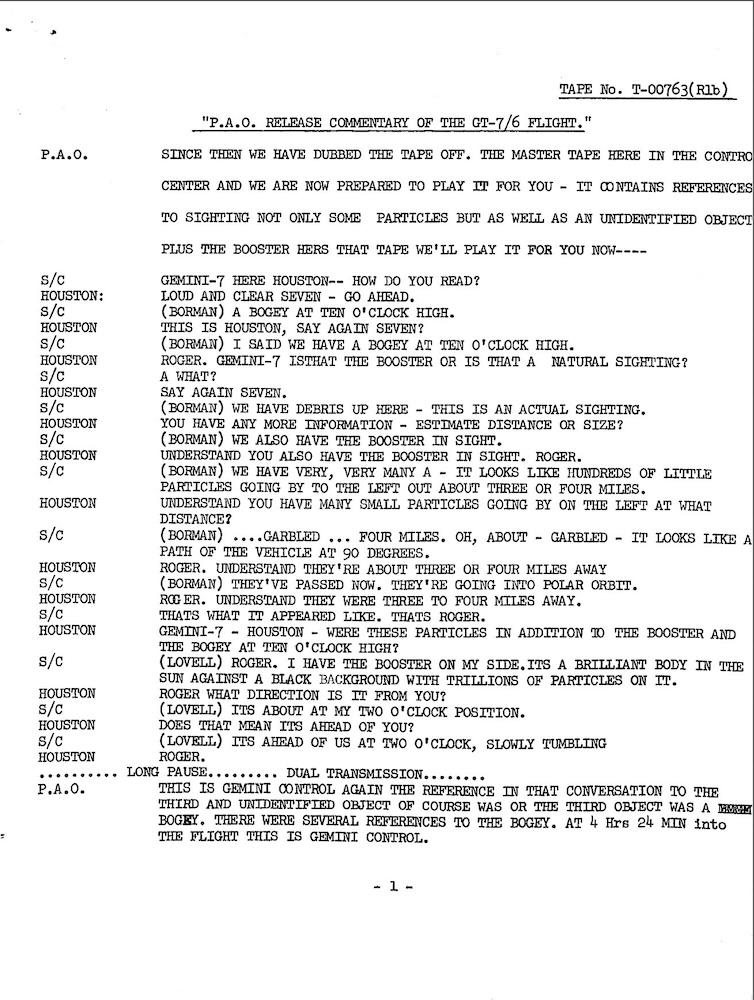
NASA-미확인 이상 현상(UAP)-D003, 제미니 7호 기록, 1965년
제미니 7호(Gemini 7)는 미국의 10번째 승무원 우주비행이었습니다. 이 문서는 비행 승무원인 우주 비행사 James "Jim" Lovell과 Frank Borman과 텍사스 주 휴스턴에 있는 유인 비행 센터(현재 Johnson Space Center로 알려짐) 간의 통신 기록입니다. 기록은 알 수 없는 항공기와 잔해 지대에 대한 현대 명명법인 "보기"에 대한 Borman의 보고서로 시작됩니다. Borman은 잔해 지대를 "아주 아주 많은 [...] 수백 개의 작은 입자"로 구성되어 있다고 설명했습니다. 그는 우주선으로부터 입자의 거리를 4마일로 추정했습니다. Lovell은 "수조 개의 입자가 있는 검은 배경을 배경으로 태양 아래 빛나는 몸체"를 관찰했다고 설명했습니다. 이 문서에는 오른쪽 상단 모서리에 "Borman의 UFO 목격"이라는 문구가 표시된 만남을 기록한 손으로 쓴 메모도 포함되어 있습니다.

NASA-미확인 이상 현상(UAP)-D003A, Gemini 7 오디오 발췌, 1965
This audio recording contains air to ground communications and the NASA Public Affairs audio feed with commentary, recorded during the flight of the Gemini 7 mission. In this excerpted segment of audio, Astronaut Frank Borman reports to NASA mission control in Houston his sighting of an unidentified object, which he referred to as a "bogey." This sighting occurred on December 5, 1965. The dialogue includes Borman's initial report, as well as additional comments by Astronaut Jim Lovell, Borman's fellow crew member.
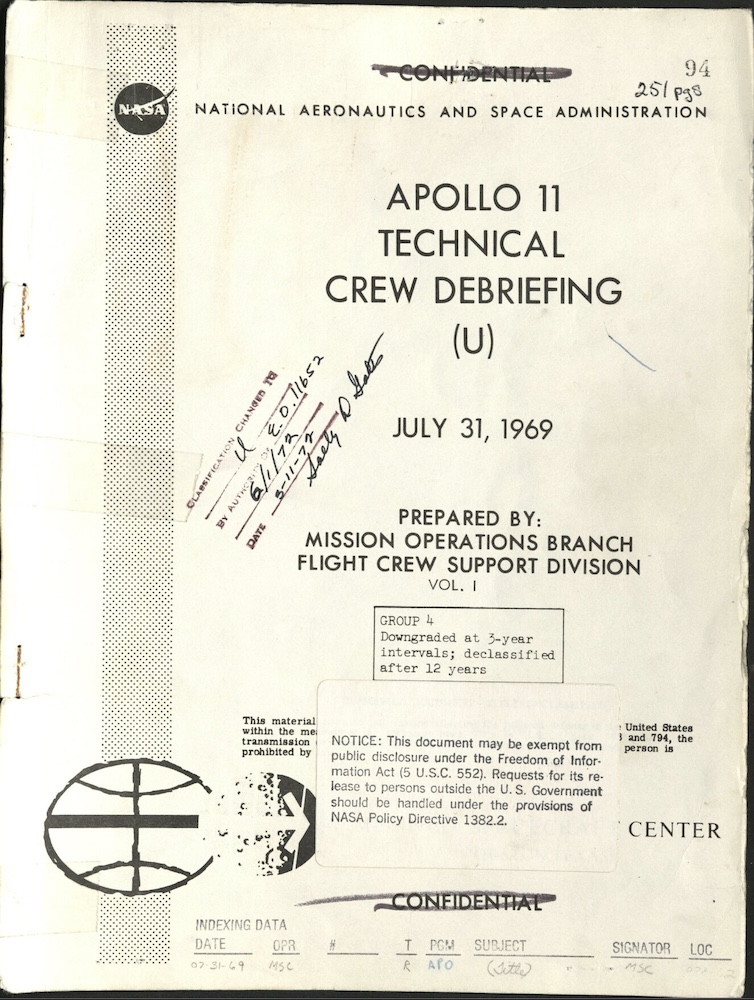
NASA-UAP-D004, Apollo 11 Technical Crew Debriefing, 1969
Apollo 11 was the third crewed mission to the Moon and the first to land Astronauts on the lunar surface. This document is an excerpt from the Apollo 11 Technical Crew Debriefing (Volumes 1 and 2) from July 31, 1969. The document highlights three observations: one, an object on the way out to the Moon; two, flashes of light inside the cabin; and three, a sighting on the return trip of a bright light tentatively assumed by the crew to be a laser. • Page 6-33 (Vol. 1). [Lunar Module Pilot for Apollo 11, Buzz Aldrin]: “The first unusual thing that we saw I guess was 1 day out or something pretty close to the moon. It had a sizeable dimension to it, so we put the monocular on it.” The crew speculated that it could have been the S-IVB stage of the Saturn V launch vehicle. • Page 6-37 (Vol. 1). [Lunar Module Pilot for Apollo 11, Buzz Aldrin] “The other observation that I made accumulated gradually. I don’t know whether I saw it the first night, but I’m sure I saw it the second night. I was trying to go to sleep with all the lights out. I observed what I thought were little flashes inside the cabin, spaced a couple of minutes apart…” • Page 21-1 (Vol. 2). [Lunar Module Pilot for Apollo 11, Buzz Aldrin] “I observed what appeared to be a fairly bright light source which we tentatively ascribed to a possible laser.”
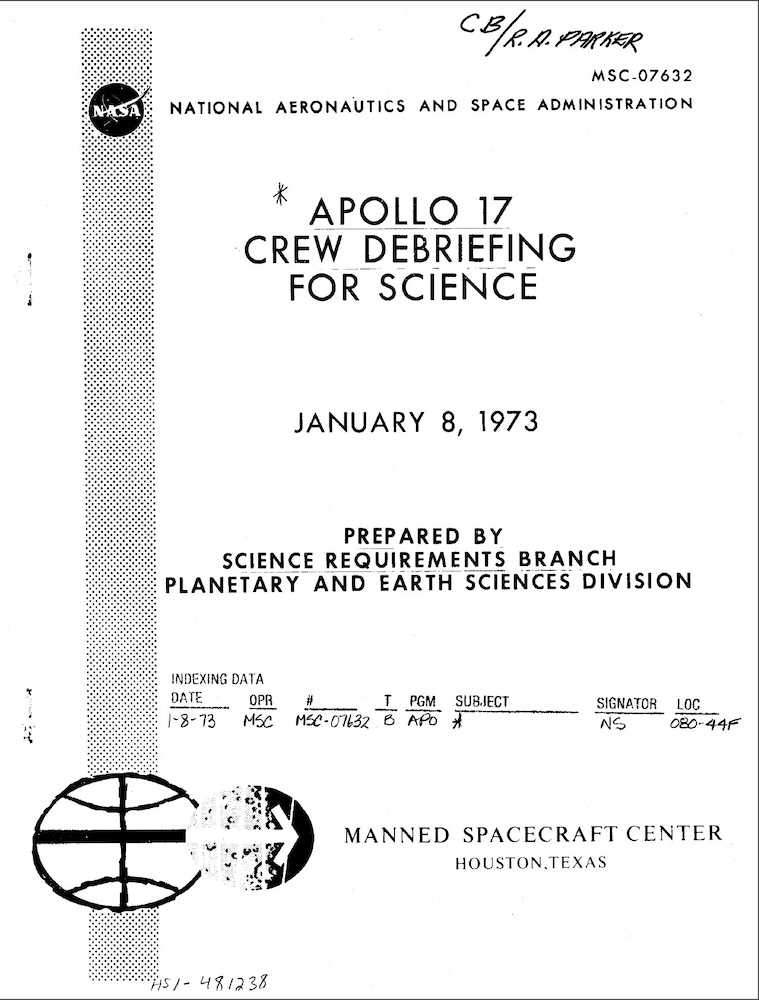
NASA-UAP-D005, Apollo 17 Crew Debriefing for Science, 1973
Apollo 17 was the ninth crewed U.S. mission to the Moon, and the sixth to land Astronauts on the lunar surface. This document is an excerpt from the Apollo 17 Crew Debriefing for Science on January 8, 1973, in which Dick Henry, co-investigator on the ultraviolet experiment on Apollo 17, discusses seeing results that were unexpected. • Pages 119-120. “One of the most exciting results of X-ray astronomy was the fact that an X-ray background was observed over the sky that nobody had expected, and part of this is the gamma-ray background that Dr. Trombka talked about. In the UV, nobody knows, but you never know until you look. You do have to deal with this background of stars that we know is there. So, we did look at a large number of different points at high galactic latitudes, both north and south. The spectrum that we see is above this dark count. In other words, this abnormally high dark current did not, in fact, interfere with that experiment. The spectrum that we see looks like the spectrum of the hot star; however, we know that there were no hot stars within our field of view. Therefore, the most conservative interpretation, I think, is that what we're seeing is light from hot stars in the galactic plane going up out of the plane and reflecting off interstellar dust. There are certain characteristics of the spectrum, though, that don't fit that theory, and it's at least possible that this is extragalactic radiation. I'm looking forward very much to the detailed computer study of this, but it's going to take a long time.”
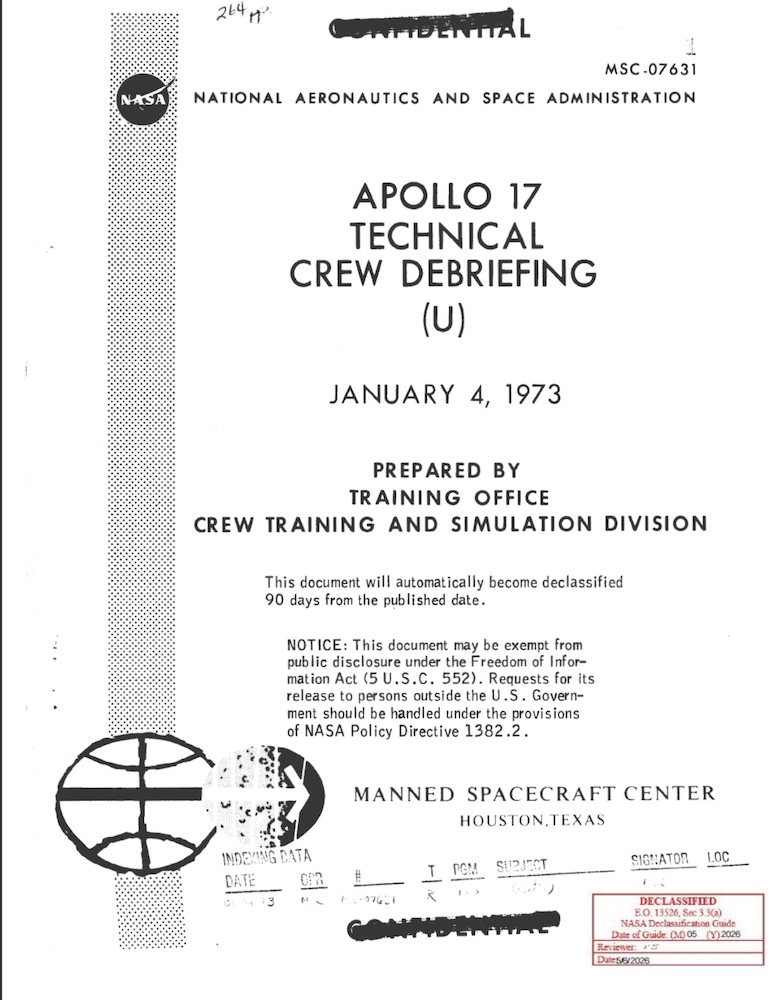
NASA-UAP-D006, Apollo 17 Technical Crew Debriefing, 1973
Apollo 17 was the ninth crewed U.S. mission to the Moon, and the sixth to land Astronauts on the lunar surface. This document is an excerpt from the Apollo 17 Technical Crew Debriefing on January 4, 1973, in which astronaut Harrison Schmitt reported seeing light flashes. • Page 24-4. [Lunar Module Pilot Harrison Schmitt]: “We had light flashes just about continuously during the whole flight when we were dark adapted. I had one which I thought was a flash on the lunar surface. That one period of time when we had the blindfolds on for the ALFMED [Apollo Light Flash Moving Emulsion Detector] experiment there were just no visible flashes, although that evening, that night, before I went to sleep, I noticed that I was seeing the light flashes again.”
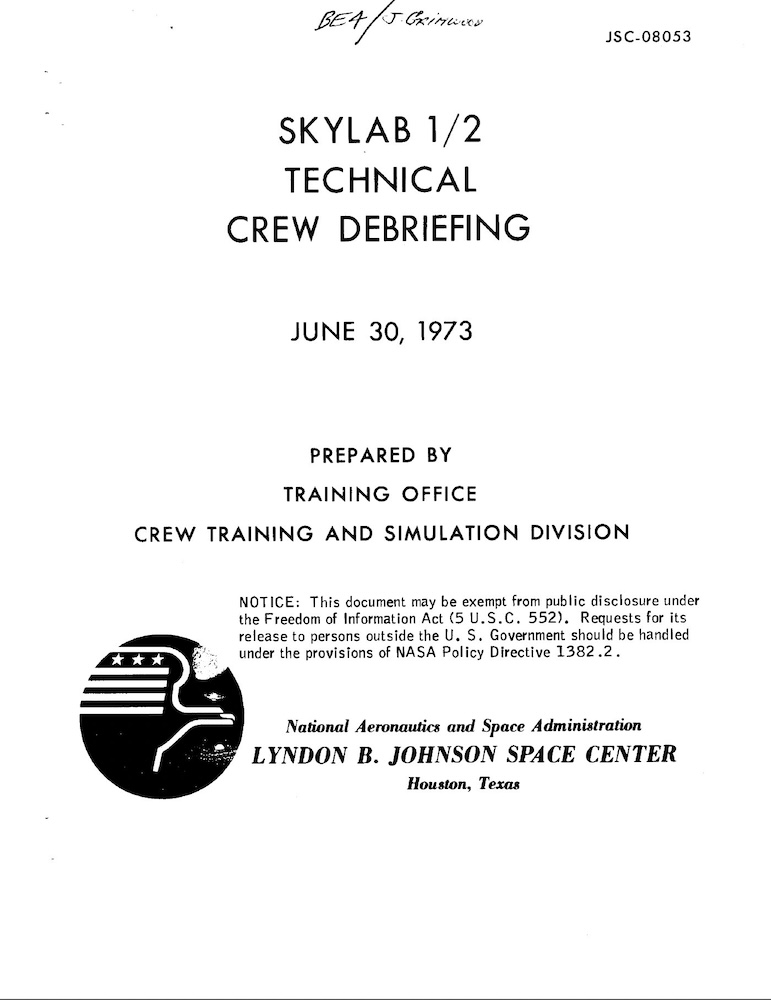
NASA-미확인 이상 현상(UAP)-D007, Skylab 기술 승무원 보고 1973
Launched on May 14, 1973, Skylab was the United States’ first laboratory in space. From 1973 to 1974, the station was visited by three crews. This document contains excerpts from all three crews to visit the station. In the first excerpt taken from Skylab 1/2 [first crew] Technical Debriefing from June 30, 1973, highlights crew observations of light flashes. The second excerpt taken from Skylab 1/3 Technical Crew Debriefing from October 4, 1973, highlights two observations—a satellite in similar orbit and another object with a “reddish hue to it.” The final excerpt taken from the Skylab 1/4 Technical Crew Debriefing from February 22, 1974, highlights an observation of flashing lights outside Skylab. • Skylab 2 crew observation: o Page 23-20. [Science Pilot for Skylab 2, Joesph Kerwin] “We saw light flashes. I think all of us saw them. I saw them most often when I was in the sack at night with my eyes closed but awake naturally. They tended to wax and wane in frequency.” • Skylab 3 crew observations: o Page 7-4. [Science Pilot for Skylab 3, Owen Garriott] “We saw that satellite about a week before splashdown. That was one of the most unusual things that we saw and I guess Jack [Lousma] noticed it looking out the window. This bright reddish object was out there and we tracked it for about 5 or 10 minutes. It was obviously a satellite in a very similar orbit to our own.” o Page 20-1. [Science Pilot for Skylab 3, Owen Garriott] “Jack [Lousma] first noticed this rather large red star out the wardroom window. Upon close examination, it was much brighter than Jupiter or any of the other planets. It had a reddish hue to it, even though it was well above the horizon.” • Skylab 4 crew observation o Page 7-8. [Commander for Skylab 4, Gerald P. Carr] “One other area of unusual events that we reported on the dump tapes was that on occasion we saw some lights flashing outside with very a definite motion relative to ours. We presumed that they were other pieces of Skylab, or possibly other satellites.”
NASA-미확인 이상 현상(UAP)-D008, 아폴로 12호 의료 보고 - 테이프 12, 1969
During a medical debriefing of the crew of the Apollo 12 mission, Commander Charles “Pete” Conrad, Command Module Pilot Richard “Dick” F. Gordon, and Lunar Module Pilot Alan L. Bean describe their observations of instances of light flashes or “streaks of lights.” The astronauts each reported that these experiences occurred in the dark as they tried to sleep. The NASA medical team considered whether similar phenomena reported by Apollo 11 Lunar Module Pilot Buzz Aldrin had been attributable to exposure of the retina by cosmic rays. NASA later determined that the phenomena reported by the Apollo 12 flight crew were internal to the astronauts’ vision rather than external light sources.
NASA-미확인 이상 현상(UAP)-D009, 아폴로 17호 오디오 발췌, 1972년 12월 7일
During the eleventh and final crewed mission in the Apollo program, Apollo 17 Commander Gene Cernan, Lunar Module Pilot Harrison Schmitt, and Command Module Pilot Ronald Evans report seeing small lights outside the Apollo spacecraft during transit to the moon. The crew describe bright “particles” or “fragments” as being “jagged,” “angular,” and drifting near the Apollo spacecraft and the separated Saturn S-IVB stage. The Apollo 17 crew speculate that paint chips or ice chips are likely the source of these lights and note that they “twinkle” and move away from the Saturn S-IVB stage.
NASA-미확인 이상 현상(UAP)-D010, 머큐리 아틀라스 9 오디오 발췌, 1963년 5월 15일
Approximately one hour and 41 minutes into the final and longest flight of Project Mercury, Mercury-Atlas 9 mission (MA-9) Faith 7 Pilot L. Gordon Cooper Jr. notes that he sees “John’s fireflies,” referring to John Glenn’s term from the Mercury-Atlas 6 mission. NASA later determined that the “fireflies” are attributable to frozen condensation separating from the spacecraft body. The white, green-hued appearance of this phenomenon results from sunlight reflecting off frozen condensation.
NASA-미확인 이상 현상(UAP)-D011, 머큐리 아틀라스 9 오디오 발췌, 1963년 5월 15일
머큐리 프로젝트의 마지막이자 가장 긴 비행 동안 머큐리-아틀라스 9 임무(MA-9) Faith 7 조종사 L. Gordon Cooper Jr.는 지구 대기의 안개층 아래에서 빛나는 푸른 일출을 묘사합니다. 그는 일출이 다가올 때 우주선에서 멀어져가는 작고 빛나고 찬란한 흰색 입자를 묘사합니다. Cooper는 크세논 스트로브 조명을 갖춘 구형 임무 관련 장비인 비콘을 배치한 후 "반딧불이"를 관찰한다고 설명합니다.
NASA-미확인 이상 현상(UAP)-D012, Mercury Atlas 8 오디오 발췌, 1962년 10월 3일
During the Mercury Atlas 8 mission, Sigma 7 pilot Walter M. “Wally” Schirra Jr. describes observing “little white objects that tend to come from the capsule itself and drift off.” Schirra later also refers to those objects as “particles” and “lathe shavings.” Schirra also describes seeing a burst of light in the window, whose source he cannot identify. He speculates that his observation corresponds with the moment the sun passes below the horizon during sunset.
NASA-미확인 이상 현상(UAP)-D013, 머큐리 아틀라스 7호, 1962년 5월 24일
During the fourth crewed spaceflight and second orbital flight of Project Mercury, Mercury-Atlas 7 (MA-7), Aurora 7 pilot Scott Carpenter describes white particles in view that appear to move at “random” and “look exactly like snowflakes.” He describes these phenomena as reflective, and that some seemed to move faster than the Aurora 7 spacecraft.
NASA-미확인 이상 현상(UAP)-D014, 머큐리-레드스톤 4, 1961년 7월 21일
During the recovery of the fourth launch and second crewed spaceflight of Project Mercury, Mercury-Redstone 4 (MR-4) Liberty Bell 7, the recovery team discusses a dye pack in the water that did not activate.
NASA-UAP-D015, Astronaut Scientific Debriefings, 1962-1963
이 파일에는 우주비행사 존 글렌(John Glenn)과 월터 쉬라(Walter Schirra)가 우주 비행 중 보고한 발광 현상의 본질을 조사하는 데 대한 현대 과학적 관심과 관련된 메모, 서신, 보고서 및 기타 자료가 포함되어 있습니다. 이 컬렉션에는 관찰 내용에 관해 NASA 인터뷰 및 두 우주비행사와의 보고 내용이 포함되어 있습니다. 또한 발광 입자에 대한 간략한 설명, 우주선 탑승 중 경험, 대기로 유입되는 유성 입자에 대한 1955년경 이론적 분석을 포함하여 대기 현상에 대한 과학적 관찰과 관련된 세부 정보가 포함되어 있습니다. 페이지 34-35, 55-56, 57-63, 64-113, 122-127에는 PURSUE 시스템 이니셔티브와 관련된 내용이 나와 있습니다.
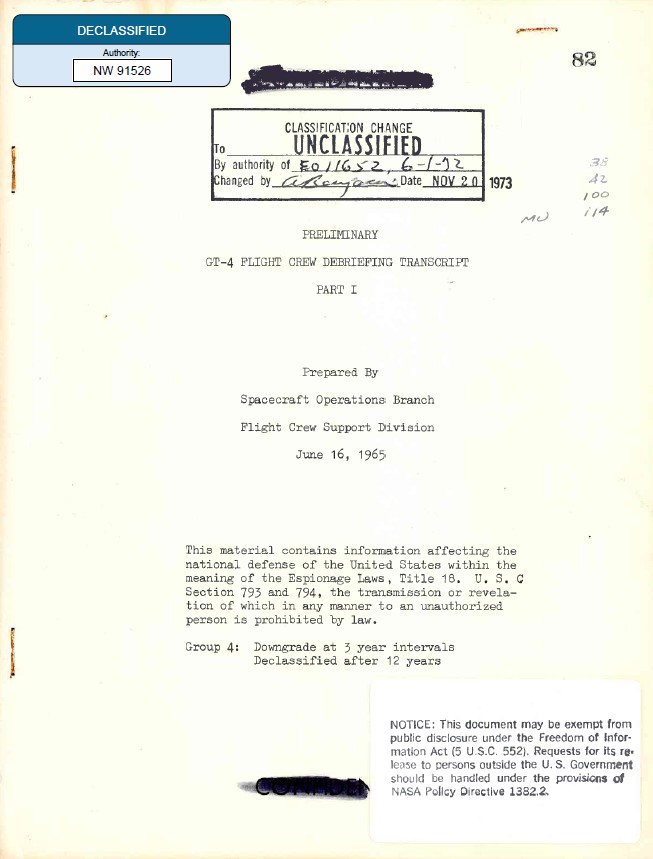
NASA-미확인 이상 현상(UAP)-D016, 예비 Gemini 4 승무원 보고, 1부, 1965
This document is a preliminary transcript (Part I) derived from voice recordings of the Gemini 4 flight crew debriefing taken aboard the recovery ship, USS Wasp, on June 9, 1965. Astronaut Ed White recounts seeing “sparkles” during the flight.
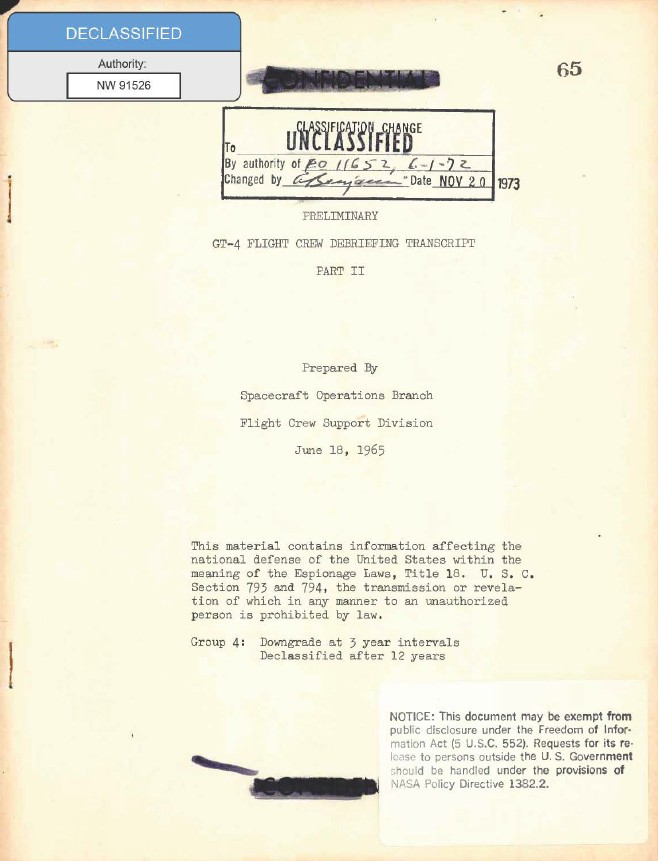
NASA-미확인 이상 현상(UAP)-D017, 예비 Gemini 4 승무원 보고, 파트 II, 1965
This document is a preliminary transcript (Part II) derived from voice recordings of the Gemini 4 flight crew debriefing taken aboard the recovery ship, USS Wasp, on June 9, 1965. Part II of this document contains the “Visual Sightings” section of the debriefing (pages 196-224), where astronauts James McDivitt and Edward White describe their observations while aboard the spacecraft.
NASA-미확인 이상 현상(UAP)-D018, Gemini 4 실험 보고, 1967년
Gemini IV는 Gemini 시리즈의 두 번째 승무원 임무였습니다. 우주 비행사 James McDivitt와 Edward White는 1965년 6월 3일부터 6월 7일까지 4일간의 비행을 성공적으로 완료했습니다. 임무에는 미국 최초의 우주 유영이 포함되었습니다. 이 문서 모음에는 1967년 6월 25일경에 우주비행사가 우주선 외부의 밝은 입자를 관찰한 내용을 기록한 기록이 78~81페이지 및 101페이지에 포함되어 있습니다.
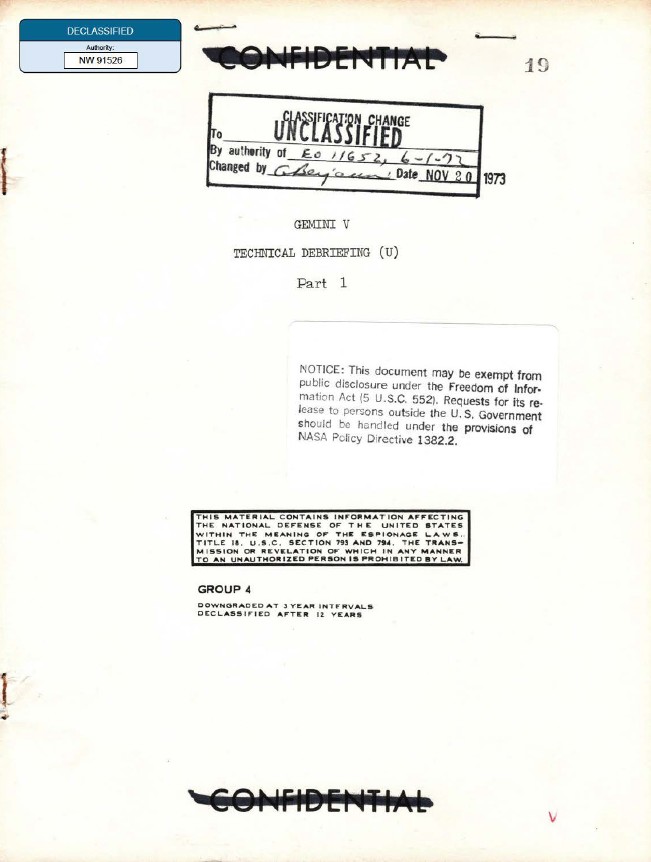
NASA-미확인 이상 현상(UAP)-D019, Gemini 5 기술 보고, 1부, 1965
This document is a preliminary transcript (Part I) derived from voice recordings of the Gemini 5 flight crew technical debriefing. NASA conducted this debriefing between August 30, 1965, and September 2, 1965, at the Crew Quarters, Cape Kennedy, Florida.
NASA-미확인 이상 현상(UAP)-D020, Gemini 5 기술 보고, 파트 II, 1965
This document is a preliminary transcript (Part II) derived from voice recordings of the Gemini 5 flight crew technical debriefing. NASA conducted this debriefing between August 30, 1965, and September 2, 1965, at the Crew Quarters, Cape Kennedy, Florida. Astronauts L. Gordon Cooper and Charles “Pete” Conrad described observing debris and “snow” and “all sorts of glittering pieces of this, that and the other thing” in the “Visual Sightings” section of the document (pages 157-220).
NASA-UAP-D021, Gemini 7 Technical Debriefing, 1965
This document is a preliminary transcript derived from voice recordings of the Gemini 7 flight crew debriefing conducted December 19-21, 1965, at the Crew Quarters, Cape Kennedy, Florida. Lights and flashes are mentioned and there is discussion about having proper illumination for vehicle docking. Borman and Lovell discuss celestial and terrestrial observational anomalies and note sightings of Mercury, meteors, aurora, and lightning. They also discuss not being able to see any stars once the Sun comes up.
NASA-미확인 이상 현상(UAP)-D022, Gemini 9 보고, 1966년
Gemini IX (renamed Gemini IX-A) was the seventh crewed flight of the Gemini series, launched on June 3, 1966. The mission’s primary objectives included a spacewalk and multiple scientific and medical experiments. This document, dated June 16, 1966, is a transcript of a NASA debriefing of astronauts Thomas Stafford and Eugene Cernan. Pages 2-5 of this document contain the astronauts’ accounts of their observations of “flashing lights” and “sparkles” during the mission.
NASA-미확인 이상 현상(UAP)-D023, 우주비행사 고든 쿠퍼와의 인터뷰 발췌, 1962년
In November 1962, journalist Walter Cronkite interviewed astronaut Gordon Cooper. In this excerpt from that interview, Cronkite asks Cooper about his views regarding the nature of unidentified flying objects, having previously expressed an interest in the subject. Cooper opines that “a large number of exceptionally well-qualified people have seen objects” without a “logical explanation” and speculates on the existence of other planets with “a livable atmosphere” and that maybe there are “some type of human life” out there. Interview was conducted in November 1962.
NASA-미확인 이상 현상(UAP)-D024, '아폴로 16호 과학 보고'
이 보고에는 다양한 Apollo 실험의 주요 조사관의 프레젠테이션이 포함됩니다. 수석 조사관은 Apollo 17 준비를 돕기 위해 Apollo 16에서 얻은 정보에 대해 Apollo 승무원을 교육하기 위한 작업의 예비 결과를 설명합니다. 또한 관찰되었지만 아직 보고되지 않은 '플래시'와 같은 변칙 사항도 설명합니다. 플래시는 25:15부터 언급됩니다.
NASA-미확인 이상 현상(UAP)-D025, '아폴로 16호 과학 보고'
At 32:41, the speaker makes an off-handed comment, “Could be an alien starbase or something, I don’t know” when discussing correlations between experimental data sets.
NASA-미확인 이상 현상(UAP)-D026, 아폴로 14호 보고, 1971년
This file contains segment 1 of 2 of the Apollo 14 post-mission crew debriefing at the Manned Spacecraft Center (now Johnson Space Center), Houston, Texas. In the recording, crew members and debriefers discuss the “light flash phenomena,” a then novel, now well-documented biological effect where high-energy cosmic rays pass through the eye and strike the retina, causing the perception of light streaks or flashes. The questioners attempt to distinguish the characteristics of the observed phenomena. The debriefing continues in the next file (NASA-UAP-D027), which contains some overlapping audio content.
NASA-미확인 이상 현상(UAP)-D027, 아폴로 14호 보고(계속), 1971
This file contains segment 2 of 2 of the Apollo 14 post-mission crew debriefing at the Manned Spacecraft Center (now Johnson Space Center), Houston, Texas. In this continued segment, crew members and debriefers further discuss the “light flash phenomena,” a then novel, now well-documented biological effect where high-energy cosmic rays pass through the eye and strike the retina, causing the perception of light streaks or flashes.
NASA-미확인 이상 현상(UAP)-D028, 아폴로 17호 승무원 의료 보고, 1972년
This file contains segment 1 of 2 of the Apollo 17 post-mission medical debriefing at the Manned Spacecraft Center (now Johnson Space Center), Houston, Texas. In the recording, crew members discuss the “light flash phenomena,” a then novel, now well-documented biological effect where high-energy cosmic rays pass through the eye and strike the retina, causing the perception of light streaks or flashes. Two of the three crew members reported observing these flashes at various points during the mission, including in lunar orbit and while on the lunar surface. The debriefing continues in the next file (NASA-UAP-D029).
NASA-UAP-D029, Apollo 17 Crew Medical Debriefing (Continued), 1972
This file contains segment 2 of 2 of the Apollo 17 post-mission medical debriefing at the Manned Spacecraft Center (now Johnson Space Center), Houston, Texas. In this continued segment, crew members and debriefers further discuss the “light flash phenomena,” a then novel, now well-documented biological effect where high-energy cosmic rays pass through the eye and strike the retina, causing the perception of light streaks or flashes. Two of the three crew members reported observing these flashes at various points during the mission, including in lunar orbit and while on the lunar surface.
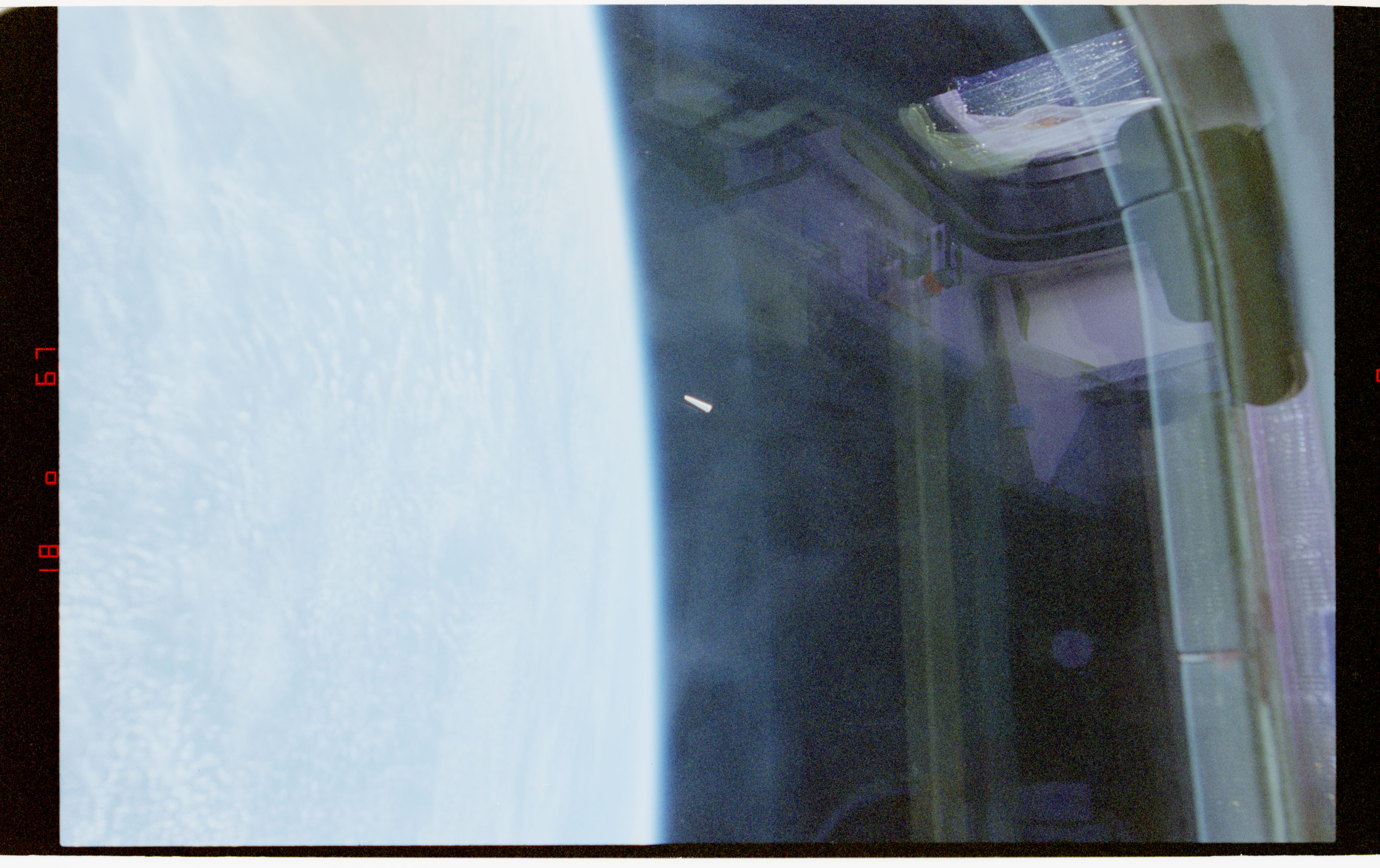
NASA-미확인 이상 현상(UAP)-D030, STS-80 미확인 물체 이미지 1, 1996
During STS-80, between November 19 and December 7, 1996, astronauts aboard Space Shuttle Columbia captured a series of three images of an unidentified object in low-Earth orbit. In the first photograph, the object is visible near the center of the frame, to the right of the limb of the Earth.
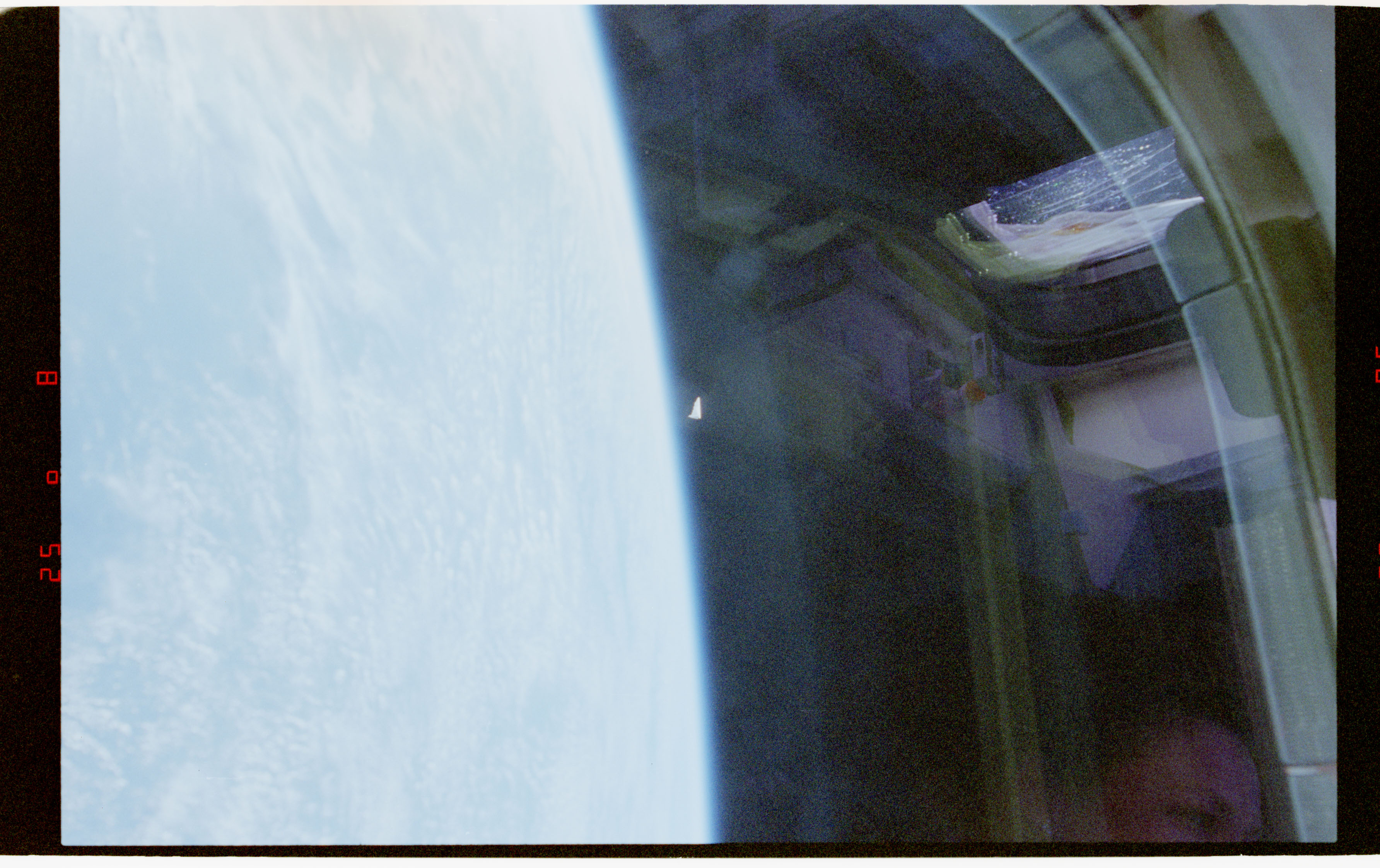
NASA-미확인 이상 현상(UAP)-D031, STS-80 미확인 물체 이미지 2, 1996
During STS-80, between November 19 and December 7, 1996, astronauts aboard Space Shuttle Columbia captured a series of three images of an unidentified object in low-Earth orbit. In the second photograph, the object is visible near the center of the frame, to the right of the limb of the Earth. It appears to have rotated or tumbled about its major axis, which is consistent with the behavior of a free-floating object.
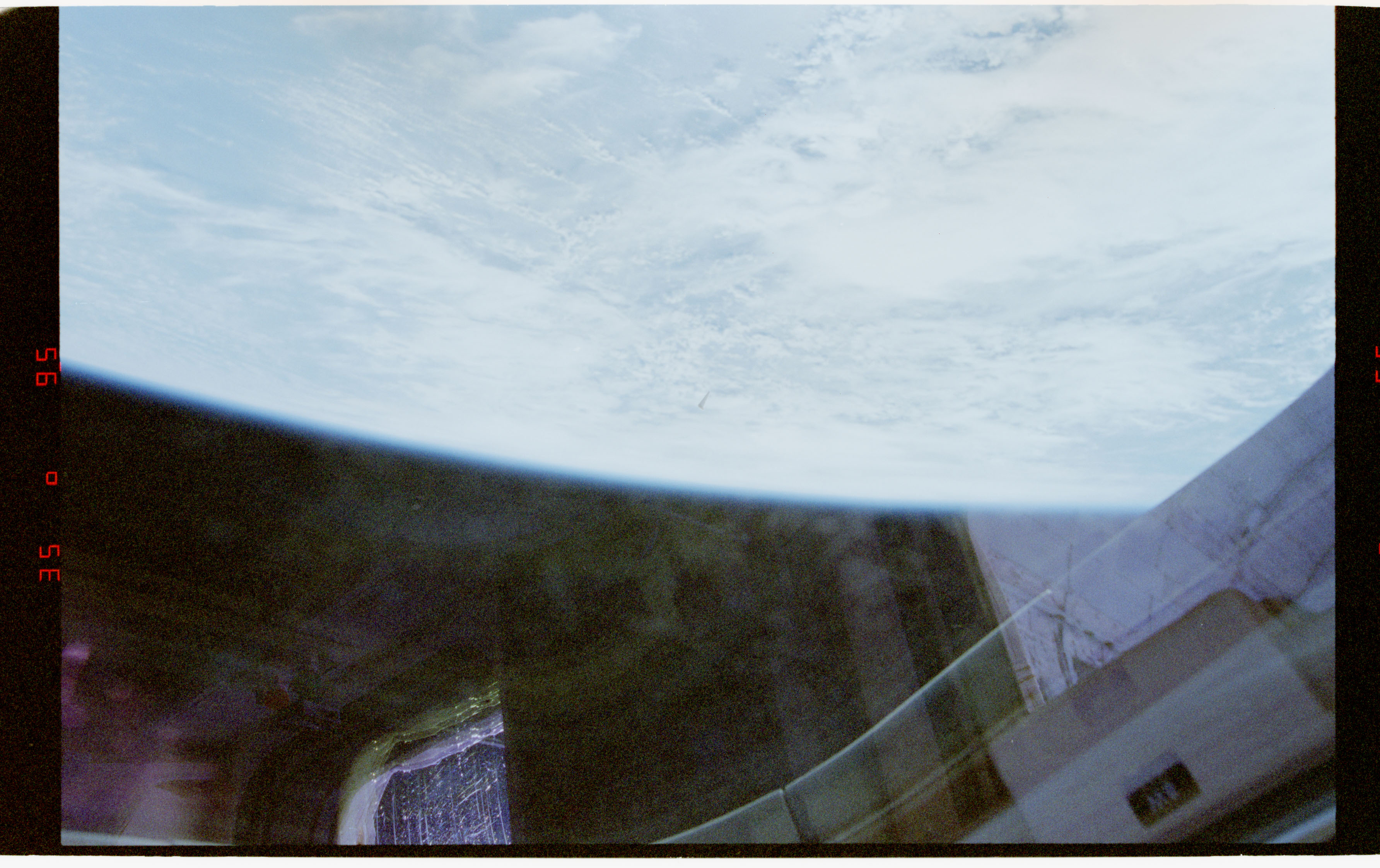
NASA-UAP-D032, STS-80 Unidentified Object Image 3, 1996
During STS-80, between November 19 and December 7, 1996, astronauts aboard Space Shuttle Columbia captured a series of three images of an unidentified object in low-Earth orbit. In the third photograph, the object is visible near the center of the frame, superimposed against the Earth. It appears to have continued along a trajectory passing between Columbia and the Earth.
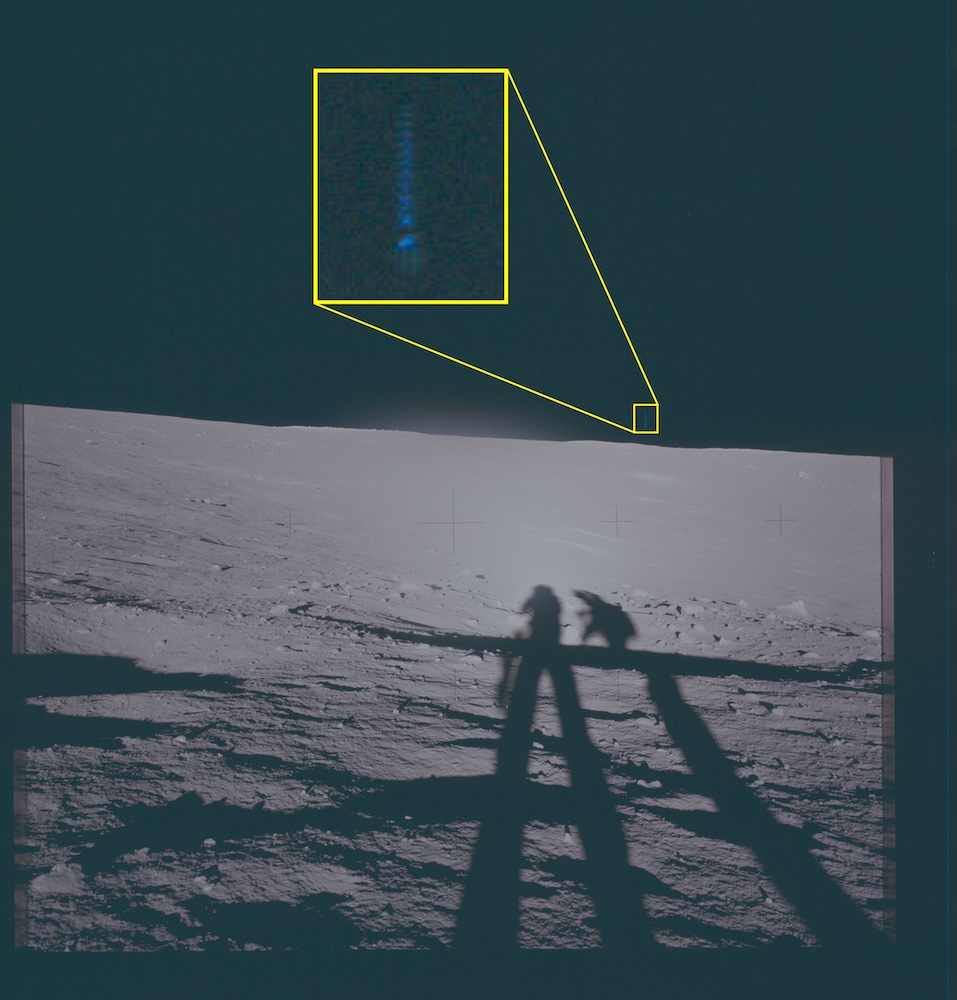
NASA-UAP-VM001, Apollo 12, 1969
This archival photograph depicts the lunar surface as viewed from the landing site of Apollo 12. This image features a highlighted area of interest slightly to the right of the vertical axis of the frame, above the horizon, in which unidentified phenomena are visible. This image has been modified from its original state to assist viewers in identifying specific areas of interest. These highlights are provided for contextual purposes only. Such alterations do not constitute an analytical judgment, investigative conclusion, or factual determination regarding the nature or significance of the subject matter.
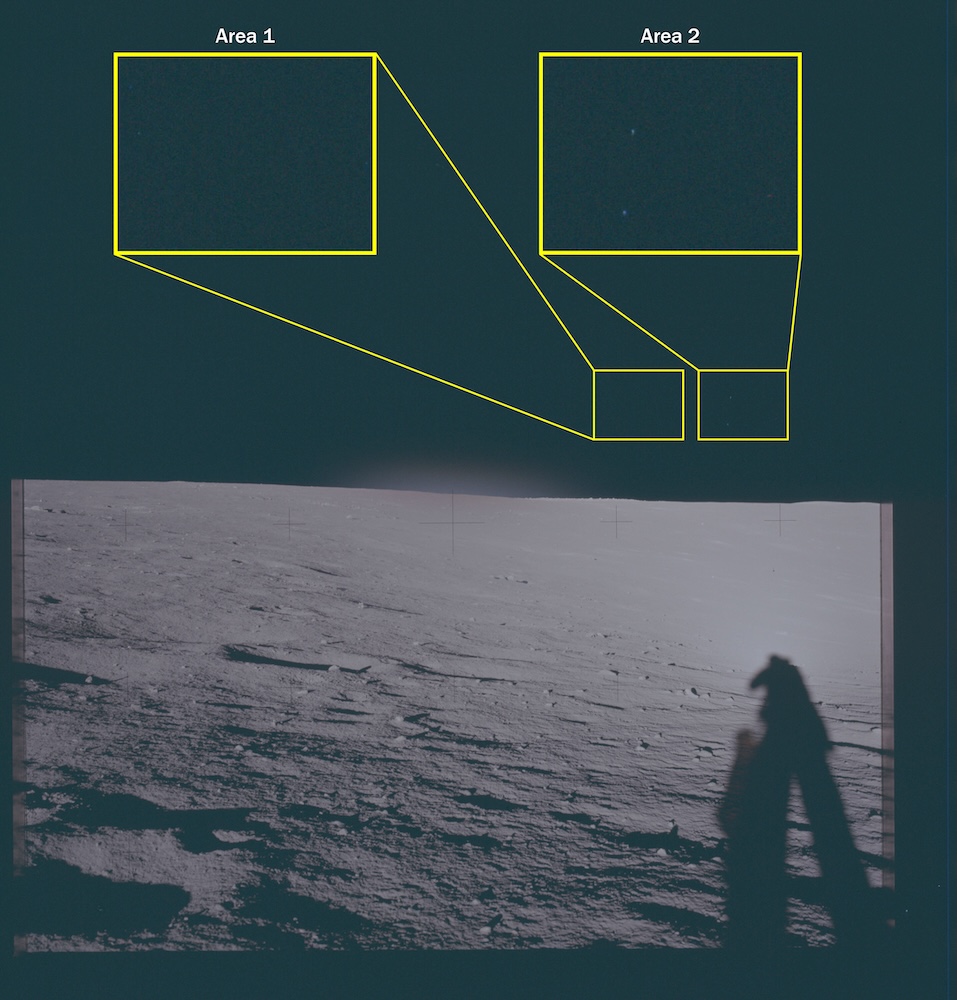
NASA-미확인 이상 현상(UAP)-VM002, 아폴로 12호, 1969년
This archival photograph depicts the lunar surface as viewed from the landing site of Apollo 12. This image features two highlighted areas of interest, labeled “Area 1” and “Area 2,” slightly to the right of the vertical axis of the frame, above the horizon, in which unidentified phenomena are visible. This image has been modified from its original state to assist viewers in identifying specific areas of interest. These highlights are provided for contextual purposes only. Such alterations do not constitute an analytical judgment, investigative conclusion, or factual determination regarding the nature or significance of the subject matter.
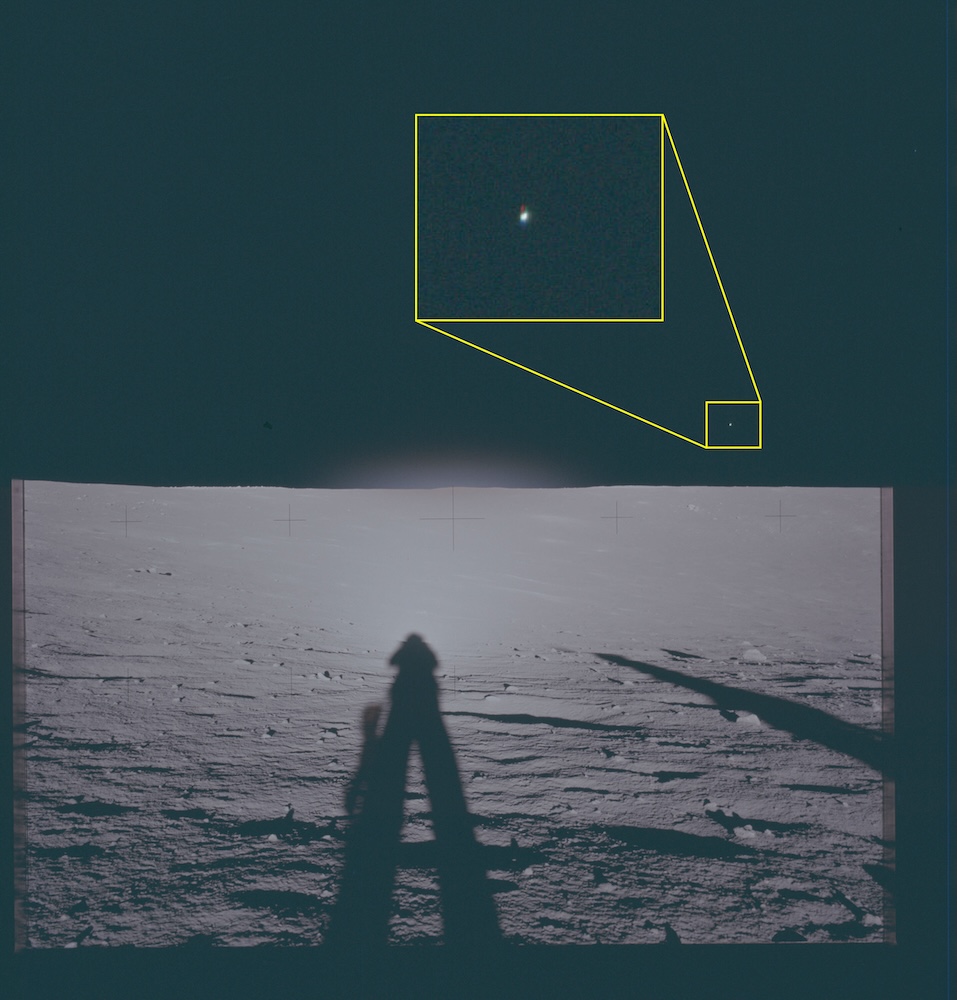
NASA-미확인 이상 현상(UAP)-VM003, 아폴로 12호, 1969년
This archival photograph depicts the lunar surface as viewed from the landing site of Apollo 12. This image features a highlighted area of interest near the right edge of the frame, above the horizon, in which unidentified phenomena are visible. This image has been modified from its original state to assist viewers in identifying specific areas of interest. These highlights are provided for contextual purposes only. Such alterations do not constitute an analytical judgment, investigative conclusion, or factual determination regarding the nature or significance of the subject matter.
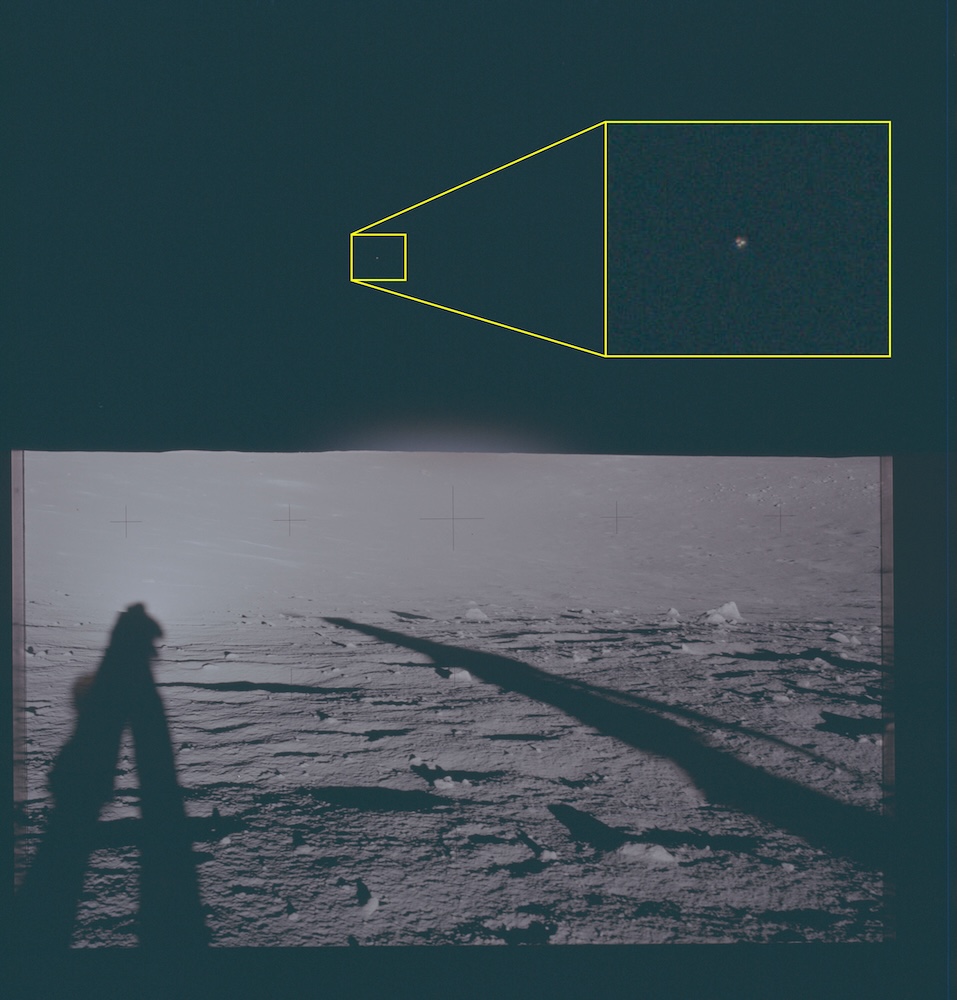
NASA-UAP-VM004, Apollo 12, 1969
This archival photograph depicts the lunar surface as viewed from the landing site of Apollo 12. This image features a highlighted area of interest slightly to the left of the vertical axis of the frame, above the horizon, in which unidentified phenomena are visible. This image has been modified from its original state to assist viewers in identifying specific areas of interest. These highlights are provided for contextual purposes only. Such alterations do not constitute an analytical judgment, investigative conclusion, or factual determination regarding the nature or significance of the subject matter.
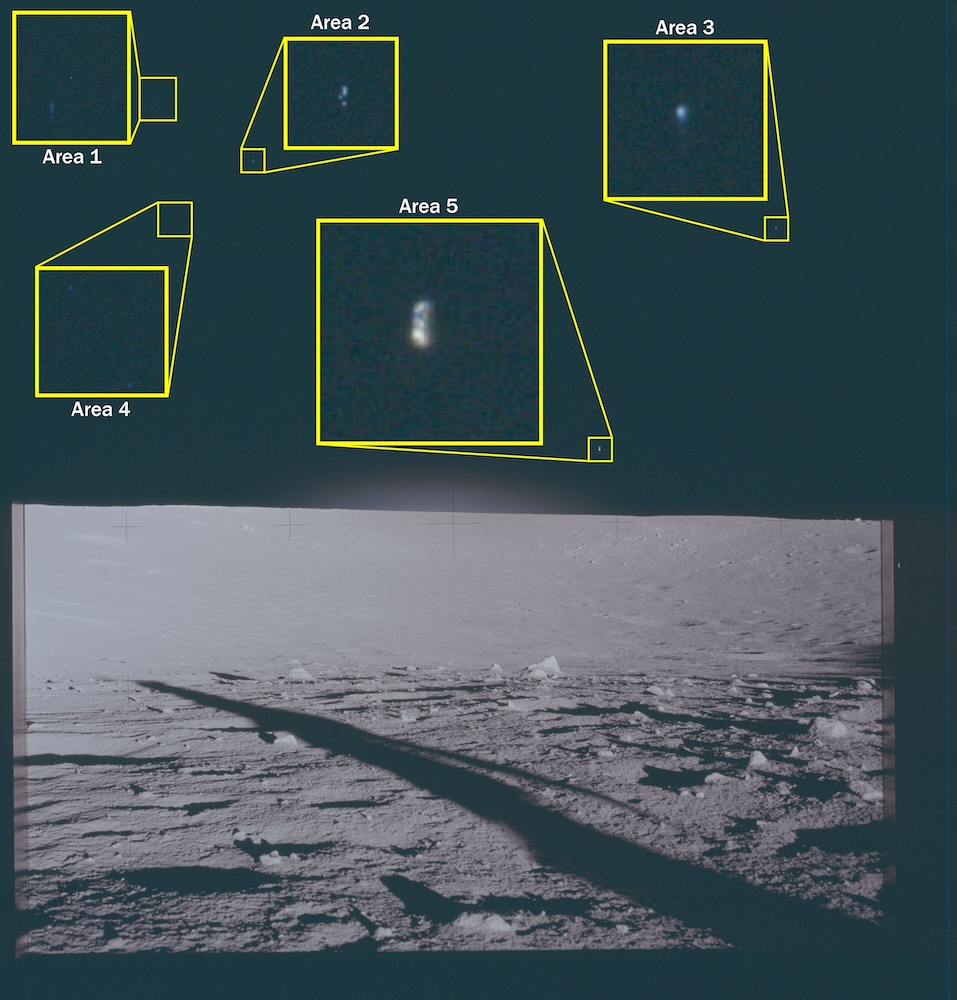
NASA-미확인 이상 현상(UAP)-VM005, 아폴로 12호, 1969년
This archival photograph depicts the lunar surface as viewed from the landing site of Apollo 12. This image features five highlighted areas of interest, labeled “Area 1” through “Area 5,” above the horizon, in which unidentified phenomena are visible. This image has been modified from its original state to assist viewers in identifying specific areas of interest. These highlights are provided for contextual purposes only. Such alterations do not constitute an analytical judgment, investigative conclusion, or factual determination regarding the nature or significance of the subject matter.
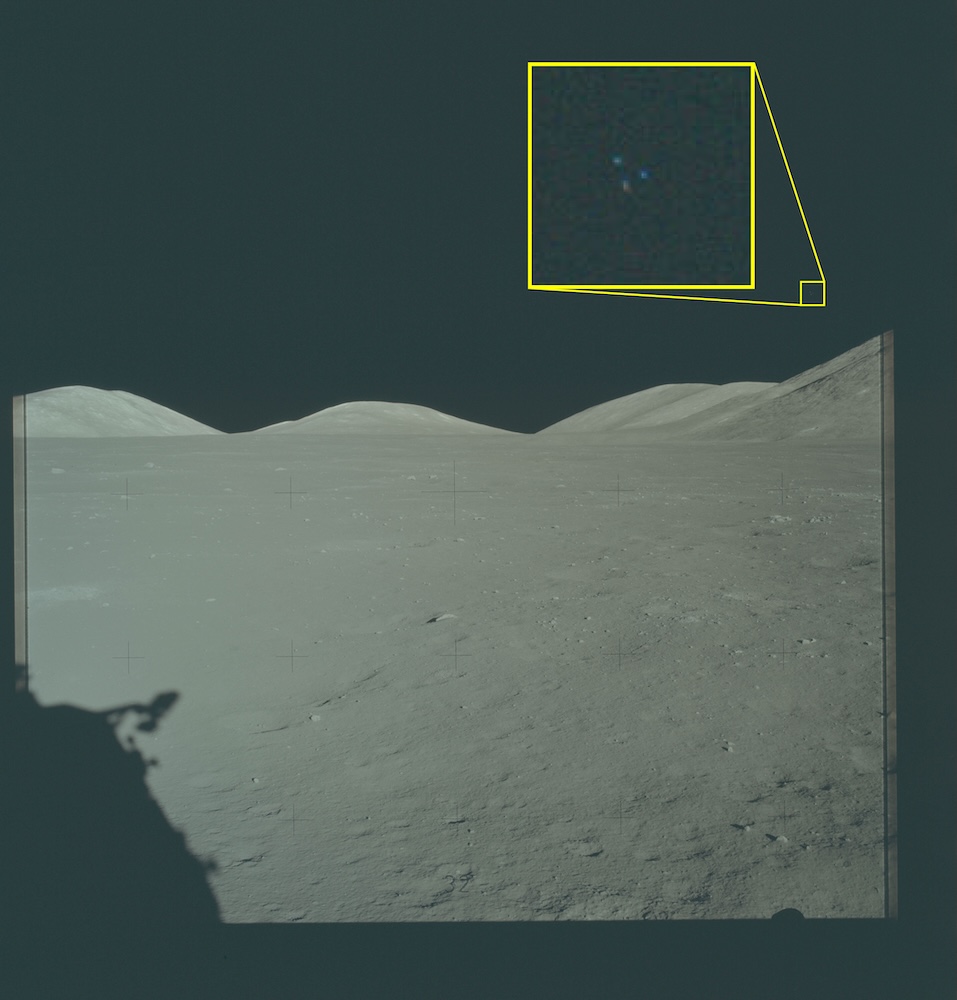
NASA-미확인 이상 현상(UAP)-VM006, 아폴로 17호, 1972
As part of the review of historical UAP materials under PURSUE, DOW has opened a case to investigate the accompanying NASA photograph from the Apollo 17 mission, taken December 1972. The image contains three “dots” in a triangular formation in the lower right quadrant of the lunar sky that is clearly visible upon magnification of the image. While this photo has been previously released and discussed by keen observers, there is no consensus about the nature of the anomaly. New preliminary US government analysis suggests the image feature is potentially the result of a physical object in the scene. Additionally, as part of this investigation, the government has obtained the original film from the Apollo 17 mission and the results of the full NASA and DOW analysis will be released when completed.