NASA-미확인 이상 현상(UAP)-D017, 예비 Gemini 4 승무원 보고, 파트 II, 1965
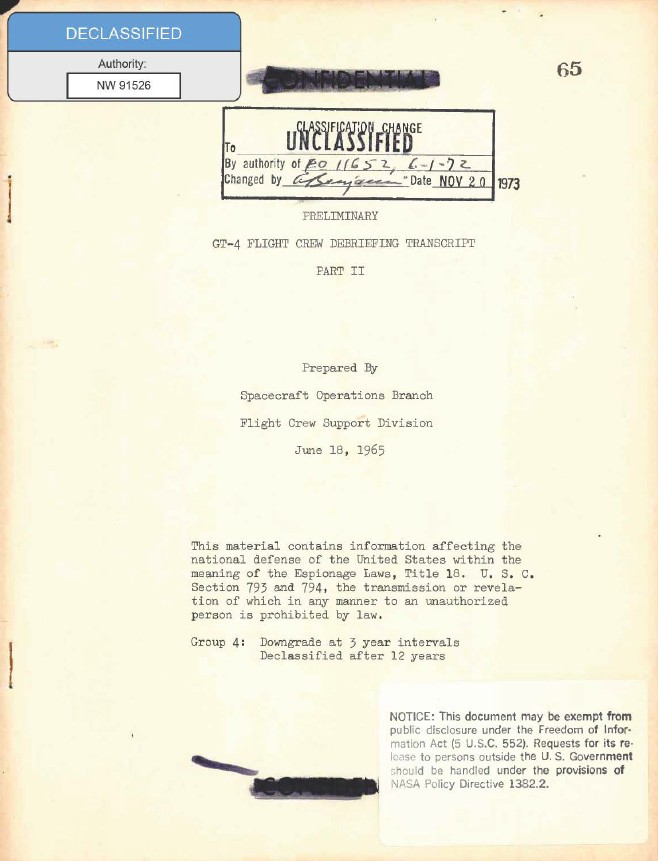
원문 (English) 보기
This document is a preliminary transcript (Part II) derived from voice recordings of the Gemini 4 flight crew debriefing taken aboard the recovery ship, USS Wasp, on June 9, 1965. Part II of this document contains the “Visual Sightings” section of the debriefing (pages 196-224), where astronauts James McDivitt and Edward White describe their observations while aboard the spacecraft.
• 권위: 65 NW 91526 당신의 r{ft~E tfFj~f에게 -----------"-==------~ -E---'-:---'--'-=--::...-~-=-__,___.c.....:::=---1의 권한으로 내가 Y--..£:::%:.:~~!l"~~==--에 의해 변경됨 예비 GT-4 비행 승무원 보고 기록 2부 작성자 우주선 작전 지점 항공승무원지원과 1965년 6월 18일 이 자료에는 다음 사항에 영향을 미치는 정보가 포함되어 있습니다. 미국의 국방은 간첩법 제18편의 의미. U. S. c. 섹션 793 및 794, 전송 또는 공개 어떤 방식으로든 승인되지 않은 사람에게 사람은 법으로 금지되어 있습니다. I 그룹 4: 3년 간격으로 다운그레이드 12년 만에 기밀해제 주의 사항: 이 문서는 다음 사항에서 제외될 수 있습니다. 정보의 자유에 따른 공개 메이션법(5 U.S.C. 552). 재요청 미국 정부 외부인에게 임대 의 조항에 따라 처리되어야 합니다. NASA 정책 Direct:ve 1382.2. • • 나 서문 이 예비 녹취록은 음성 테이프로 작성되었습니다. -녹음3 회수선에서 진행된 GT-4 비행 승무원의 보고, USS Wasp, 1965년 6월~' 유인 우주선에서 착륙 1965년 6월 12일 센터. 비록 이 녹취록에 포함된 모든 자료는 편집, 미션별 예비 녹취록이 시급하다 분석 담당자는 해당 기사가 게재되기 전에 철저한 편집 검토를 배제했습니다. 출판. 본 내용에 오류가 있는 경우 즉시 수정하겠습니다. 가능하며 공식 성적표는 추후 공개될 예정입니다. Thia 문서에는 두 번째 부분의 사본이 포함되어 있습니다. 총보고. 첫 번째 부분의 예비 사본은 다음과 같습니다. 1965년 6월 16일에 출판되었으며 승무원의 설명이 포함되어 있습니다. 작전적 관점에서 임무를 수행한다. 4Fl8E!I ← • 나는 Jlt'&' 목차 단락 페이지 번호 8.0 시스템 운영 8. 1 Pla tfo:r,n ........................................................... 1 8.2 O..AMS .....................................................................................................5 8. 3 RCS ..................................................., ...17 8.4 환경관리 시스템 •···········22 8.5 CoDlDlunication ............................................................68 8.6 전기 시스템 .............................................82 8. 7 컴퓨터 ..........................................................87 8.8 승무원 스테이션 ................................................. 93 8. 9 생물의료..........................................................134 9.0 운영수표 9. 1 아폴로 랜드마크 식별(D-6) ..............144 9.2 Apollo Yaw 방향 •••·····························168 9.3 원 애티튜드 스러스터 고장 확인 ...................................171 9.4 Horizon 스캐너 트랙 점검 •·•••·• ••·•· ••· ••••·•·•••172 9.5 Horizon 스캐너 확인 .......................................................173 ~ 9.6 HF 전송 수신 확인 ................................................181 9·. 7 궤도 항법 확인 .................................182 9.8 상대습도 테스트 .....................................185 9.9 황도광 확인 ..............................................186 10.0 시각적 목격 10.1 Cotllltdo\.lll .................•••.................................. 188 10. 2 동력 비행 . ................................... .. . 188 10. 3 궤도비행 . .......................................191 10.4 재진입 .......................................................... 213 11.0 실험 11 . 1 2색 지구-사지 사진(MSC-10) .............217 11.2 종관 지형 및 기상 사진(S-5 및 S-6).219 11.3 육분의를 이용한 간단한 탐색 ..............................219 11.4 정전기 전하(MSC-1) .....................................................229 11.5 양성자-전자 분광계와 삼축 Flus-Ga.te 자력계(MSC-2 및 MSC-3) ..................................229 11.6 방사선( D-8) .....................................................230 11.7 기내훈련기(M-3) .............................................230 11 .8 기내 심전도(M-4) . . ......................232 11.9 차량 외 활동. ...............................232 11. 10 기타 .....................................................232 12.0 임무 전 계획 12.1 임무 계획(궤도) .................. .. ....234 12.2 비행 계획 ....................... ... .. .. ...............234 12.3 우주선 변경 ............. ... . . .................239 12. 4 미션 규칙 ........................ . ....... . . . .... . ......240 12.5 실험..........................................................241 12. 6 교육 활동 ........................ . . ..........245 13.0 임무 통제 13.1 GO/NO GO ............. .. .................. 249 13. 2 PLA 및 CLA 업데이트 ..............................................249 13. 3 소모품 ............... ... ............... .. ........249 13.4 비행 계획 변경 ....................... ..................250 13.5 시스템 ..............................................254 14.0 훈련 14.1 제미니 미션 시뮬레이터 ..... .. .. ................ .... .255 14.2 LTV 시뮬레이션 .............. ...... . ........ .... ..260 14.3 원심분리기 ............. .. .......... . ... ......261 14.4 번역 및 도킹 훈련기 ....... .. ............ ...262 14.5 천문관 ..................................... .. ...263 14.6 시스템 브리핑 ................................ . ...266 14.7 비행 실험 .............................. ... ...267 14.8 우주선 시스템 테스트… ...... ... ... . . .. .... ... .. ...273 14. 9 탈출 훈련 ....................... .. ..... : .... . ..274 14. 10 낙하산 훈련 ................... . . ... ............275 14. 11 시뮬레이션 실행 . . . . . . . . . . . . . . . . . . . . . .............. .276 14.12 네트워크 시뮬레이션. .... . ............ . . .. . . . . . . . . . .....277 14. 13 제로 "G" 비행 ........ . .......... ... . .. . .. . ... . ......278 14. 14 비행 계획 훈련 ..............................................279 8.0 시스템 운영 8. 1 플랫폼 McDivitt 실제로 모든 정렬의 첫 번째 부분은 다음과 같습니다. 물건을 가두기 위해. 물건을 감금한 사례 정렬 자체보다 훨씬 더 중요합니다. 낮에는 접시를 케이지에 넣을 수 있다고 느꼈습니다. 플러스 또는 마이너스 오류가 있는 참조 형식 모든 축에서 약 3~4도. 당신은 생각 했나요? 우리가 할 수 있겠지? 흰색 낮에만. McDivitt 요는 약간의 문제였습니다. 시간이 더 걸렸어요 얻으려고 노력했지만 한동안 계속 지켜봤다면 나는 당신이 단지 몇 가지로 내려갈 수 있다고 느꼈습니다 도. 흰색 몇도 이내. McDivitt 중요한 것은 요잉을 멈춰야 한다는 것입니다 요금을 정하고 거기 앉아서 밖을 보세요. 잠시 후에 어느 방향으로 가는지 확인하세요. 직진하세요. 앞이든 옆이든. 옆으로 가는 경우 너는 잠시 돌아서 속도를 멈춘다. 그리고 다시 살펴보세요. 오른쪽? 나는 당신이 할 수 있다고 느꼈다 물건을 아주 잘 가둬두세요. 우리. 안 그랬어 전혀 BEF였나요? 우리는 BEF에서 케이지를 한 적이 없습니다. --, 2 흰색 잘 모르겠어요. McDivitt 스몰 엔드 포워드를 사용한 것의 케이지 낮에는 비교적 쉬웠습니다. 밤에는 안 해요 그렇게 간단할 거라고 생각하세요. 내 생각엔 밤에 해야 할 일은 가리키는 것입니다 우주선이 거의 땅에 내려와 있어서 땅 건너편에 선로가 보이잖아요. 내 아래서 땅이 어느 방향으로 움직이고 있는지 살펴보세요. 나 비록 나는 이것을 해본 적이 없지만 만약 내가 할 수 있다면 그렇게 하고 내가 없는 곳으로 돌아다녀 뱅크 각도, 내 요 방향을 향하거나 작은 끝 또는 무딘 끝이 앞쪽으로 있는 경우 거기에서 롤을 중지합니다. 그리고 지평선까지 올라가서 거기에 가둘 수 있었어 확실히 플러스 마이너스 10도 이내입니다. 그것은 밤에는 훨씬 덜 정확하다고 느꼈습니다. 낮. 화이트 농담이 아니군요! 우리 둘 다 그걸 느꼈어 정말 아무것도 보이지 않는 어두운 밤 지상에서는 요에 대한 순수한 별 참조가 있었습니다. 꽤 거칠다. 요에 대한 McDivitt Pure 별 참조는 거의 불가능했습니다. 사용합니다. 그게 유일한 곳이었어 우리는 우리와 함께하지 않기로 결정했습니다. 창문 너머로 별이 보였습니다. 아마도 별이었을 것입니다. 3 우리에게 사용하십시오. 우리는 우리의 길을 따라 별을 알고 있었지만 당신은 그들을 충분히 볼 수 없었습니다. 가장 빠른 요 참조를 얻는 방법은 아래를 내려다보는 것이었습니다. 땅. 플랫폼을 우리에 갇히고 일렬로 세우면 내용은 아주 간단했습니다. 당신이 해야 할 일은 단지 바늘을 0으로 유지하고 플랫폼을 정렬합니다. 그 자체. 물론 스캐너도 있어야지 on, 모드 - SEF와 EEF는 동일했습니다. 우주선이 가리키는 것을 제외하고는 동일 다른 방향. 당신은 펄스를 사용하여 바늘을 잡고 바늘을 잡으십시오. null에 매우 가깝고 플랫폼 자체가 정렬되었습니다. 호라이즌 스캐너를 통해. 궤도율은 만족스러운 모드라고 생각했습니다. 실제로, 매우 좋았습니다. 화이트 Orbit Rate가 마음에 들었고, McDivitt 예, 마침내 우리가 참조한 내용이 생겼기 때문입니다. 밖을 내다보거나 땅을 볼 필요가 없었습니다. 그것은 마치 옛날 고도 표시기를 다시 가지고 있는 것처럼요. 비행기. 유일한 것은, 우리가 잘못했다는 것입니다 우주선의 궤도율이 설정되었기 때문에 처리해야 할 궤도 속도에 대해 60해리 원형 궤도를 생각해 보세요. 이것 그 짧은 시간을 관리하기 위해서였다. -lii4Q"itsll-lM.-. ~~ 평방 4 T-5에서 궤도 속도로 이동하여 역전사를 발사합니다. TR에서. 우리는 딱 맞는 요금을 원했어요 그래서 우리가 폐쇄 루프 재진입을 수행했을 때 우리는 오류가 없을 것입니다. 내가 말했듯이, 나는 아무것도 없는 세상에서 가장 정확한 플랫폼 그것과 관련이 있습니다. 디스플레이가 적절했다고 생각합니다 통제가 적절했습니다. 첫 번째 이후 몇 번이나 정말 자신감이 없었어요 플랫폼에서는 전혀요. 나는 아무것도 하지 않았다 그것에 대한 신뢰를 확립하십시오. 난 정말 안 그랬어 물건을 정리할 기회를 얻었고 나는 실제로 창밖 풍경을 확인할 수 없었습니다. 그것으로. 우리는 서둘러서 헤매고 있었어 거기. 우리는 마침내 내가 오기 전에 일을 종료했습니다 정말 많이 사용할 기회가 생겼습니다. 우리가 셋째 날 거기에서 전원을 켜고 우리는 보았습니다. 그 놈이 저쪽으로 오고 있어... -그리고 제대로 케이지에 넣어야지 우리는 창밖의 태도를 비교했고, 오래된 태도 참조가 바로 거기에 있었습니다. 그건 플랫폼에 대한 자신감이 생겼을 때. 흰색 여기서 우리는 몇 번의 내기를 잃었습니다. 맥디빗 맞습니다. 그 일로 우리는 맥주 두 잔을 잃었어 플랫폼. 역전에서 나는 많은 자신감을 얻었습니다 플랫폼에 있지만 처음 2.5분은 5 3일 동안 정말 아무 일도 없었어 신뢰를 쌓기 위해. 그것은 단지 알려지지 않은 것. White Jim은 이 분야의 대부분의 작업을 수행했으며 나는 그의 의견도 내 의견을 반영한다고 생각합니다. 8.2 OAMS McDivitt 패드에서 우리는 스러스터 점검을 했습니다. 싶었어요. 우리는 전체 사이클을 돌았고 아무것도 얻지 못했습니다. 우리는 또 다른 전체주기를 돌았습니다 마지막 항목에 도달할 때까지 아무것도 얻지 못했습니다. 우리는 요 왼쪽으로 피치 다운, 요 오른쪽으로 가고 있었습니다 피치 업, 요 왼쪽 피치 다운, 요 오른쪽 피치 위로. 두 번째 피치업에 이르렀을 때 저는 이렇게 들었습니다. 추진기가 처음으로 발사됩니다.· 흰색 당신은 그것을들을 수 있습니다. 그것은 매우 뚜렷했습니다. 맥디빗 맞습니다. 그리고 우리는 돌아다니면서 요잉을 했어요 떠났고 그들은 다시 해고되었습니다. -20초 정도 기다렸습니다 그리고 다시 왼쪽으로 요를 발사했고, 그들은 다시 발사했습니다. 이것은 하단 매니폴드 제트였습니다. 우리는 말했다, "좋아, 이제 갈 준비가 됐어." 그리고 그게 끝이었습니다. 그것의. 그래서 그것은 매우 간단한 검사였습니다. 기내 점검--작동 점검을 받았습니다. 부스터를 쫓는 동안 OAMS 시스템에서 주변. 저는 Direct, Pulse, Rate Command를 가지고 있었습니다. 르 !~FllffiPMxMii t a 제이 6 내가 그것을 쫓아다녔을 때 거기에 있었고 그게 전부였습니다. 그때 바로 사용하려고 했던 모드들만요. 나중에 에서 Reentry Rate Command를 확인하고 추력하기 전에 Rate Command를 확인했습니다. 그것 잘 작동하는 것 같았어요. 가지 않을래? 다음 편을 통해 엘리? 흰색 알았어. 소스로 들어가보겠습니다 온도와 압력, 조절된 압력, 그리고 추진제의 양. 가져 가자 먼저 온도. OAMS의 온도 줄곧 75도였습니다. 는 압력에 대한 초기 징후는 대략 다음과 같았습니다. 소스의 경우 2800psi, 소스의 경우 320psi 조절된 압력. McDivitt 수량게이지는 그 점만 빼고는 잘 작동했는데, 앞서 말했듯이, 물건이 방황하는 것 같았어요 2~4% 사이에서 위아래로, 임무 중 어디에 있었는지에 따라 달라집니다. 한 번 읽어보면 60이 될 것이고, 당신은 잠시 후에 그것을 읽었을 것입니다. 62세라면 잠시 후에 그 책을 읽게 될 것입니다. 60쯤 돌아올 거예요. 그 일이 일어난 건 내가 갔을 때였어 60을 읽고 한 번 자고 일어났더니
원문 (English) 펼치기
•
Authority: 65
NW 91526
ur
r{ft~E
To tfFj~f
-----------"-==-----~
By authority of-E---'-:---'--'-=--::....-~-=-__,___.c.....:::=---1
l
Cha nged bY--..£:::%:.:~~!l"~~==--
PRELIMINARY
GT-4 FLIGHT CREW DEBRIEFING TRANSCRIPT
PART II
Prepared By
Spacecraft Operations Branch
Flight Crew Support Division
June 18, 1965
This material contains information affecting the
national defense of the United States within the
meaning of the Espionage Laws, Title 18. U. S. c.
Section 793 and 794, the transmission or revela
tion of which in any manner to an unauthorized
person is prohibited by law.
I Group 4: Downgrade at 3 year intervals
Declassified after 12 years
NOTICE: This document may be exempt from
public disclosure under the Freedom of Infor
mation Act (5 U.S.C. 552). Requests for its re
lease to persons outside the U.S. Government
should be handled under the provisions of
NASA Policy Direct:ve 1382.2.
• • I
PREFACE
This preliminary transcript was made from voice tape -recording3
of the GT-4 flight crew debriefing conducted aboard the recovery ship,
the USS Wasp, on June~' 1965, and concluded at the Manned Spacecraft
Center on June 12, 1965.
Although all the material contained in this transcript has been
edited, the urgent need for the preliminary transcript by mission
analysis personnel precluded a thorough editorial review prior to its
publication. Errors in this transcript will be corrected as soon as
possible and an official transcript will be published at a later date.
Thia document contains a transcript of the second part of the
total debriefing. A preliminary transcript of the first part was
published on June 16, 1965, and it contains the crew' s description
of the mission from an operational standpoint.
itit 4Fl8E!I
◄ • I Jlt'&'
TABLE OF CONTENTS
Paragraph Page number
8.0 SYSTEMS OPERATION
8. 1 Pla tfo:r,n ................................................. 1
8.2 O..AMS ....... .....................•.....................•.5
8. 3 RCS ................................................, ...17
8.4 Environmental Control System •••·················••••···22
8.5 CoDlDlunications .........................................68
8.6 Electrical System ......................................82
8. 7 Computer ...............................................87
8.8 Crew Station ........................................... 93
8. 9 Bio-Medicat ...........................................134
9.0 OPERATIONAL CHEDKS
9. 1 Apollo Landmark Identification (D-6) ..................144
9.2 Apollo Yaw Orientation •••·•··•·•••·•··••·•••···•·•·•••168
9.3 One Attitude Thruster Failure Check ...................171
9.4 Horizon Scanner Track Check •·•••·•• ••·•· ••· ••••·•·••••172
9.5 Horizon Scanner Check ....................... ...... ...173
~
9.6 HF Transmission Reception Check .......................181
9·. 7 Orbit Navigation Check ................................182
9.8 Relative Humidity Test ................................185
9.9 Zodiacal Light Check ..................................186
10.0 VISUAL SIGHTINGS
10.1 Cotllltdo\.lll .................•.•......................... 188
10. 2 Powered Flight . .................................... .. . 188
10. 3 Orbital Flight . .......................................191
10.4 Reentry ..................... .......................... 213
11 .0 EXPERIMENTS
11 . 1 Two-Color Earth-Limb Photography (MSC-10) .............217
11.2 Synoptic Terrain and Weather Photography (S-5 and S-6).219
11.3 Simple Navigation with the Sextant ....................219
11.4 Electrostatic Charge (MSC-1) ..................·........229
11.5 Proton-Electron Spectrometer and Tri-Axis Flus-Ga.te
Magnetometer (MSC-2 and MSC-3) ........................229
11.6 Radiation ( D-8) .......................................230
11.7 Inflight Exerciser (M-3) ..............................230
11 .8 Inflight Phonocardiogram (M-4) . . ......................232
11.9 Extravehicular Activity . ..............................232
11. 10 Miscellaneous .................. .......................232
12.0 PRE-MISSION PLANNING
12.1 Mission Plan (Trajectory) ................. ........ ....234
12.2 Flight Plan ..................... ... .. .. ...............234
12.3 Spacecraft Changes ............. ... . . ..................239
12. 4 Mission Rules ................ ... . ....... . . . .... . ......240
12.5 Experiments ...........................................241
12. 6 Training Activities ................. .... . . ............245
13.0 MISSION CONTROL
13.1 GO/NO GO's ............. .. .................. ...........249
13. 2 PLA and CLA Updates ...................... .............249
13. 3 Consumables ............... ... ............... .. ........249
13.4 Flight Plan Changes ....................... .. ..........250
13.5 Systems ...............................................254
14.0 TRAINING
14.1 Gemini Mission Simulator ..... .. .. ................ .... .255
14.2 LTV Simulation .................. . ...... . ........ .... ..260
14.3 Centrifuge ...................... .. .......... . ... ......261
14.4 Translation and Docking Trainer ...... .. ............ ...262
14.5 Planetarium ..................................... .. . ...263
14.6 Systems Briefings ................................ .. ...266
14.7 Flight Experiments ............ ................. ... ....267
14.8 Spacecraft Systems Test .. . ...... ... ... . . .. .... ... .. ...273
14. 9 Egress Training ........................ .. ..... : .... . ..274
14. 10 Parachute Training ................... . . ... ............275
14. 11 Launch Simulation . . . . . . . . . . . . . . . . . . . . . .............. .276
14.12 Network Simulation . .... . ............ . . .. . . . . . . . . . .....277
14. 13 Zero "G" Flight ........ . .......... ... . .. . .. . ... . ......278
14. 14 Flight Plan Training .................... ..............279
8.0 SYSTEMS OPERATION
8. 1 Platform
McDivitt Actually, the first portion of any alinement is
to cage the thing. The case of caging the thing
is much more important than the alinement itself.
In the daytime I felt that I could cage the plat
form to a reference with an error plus or minus
about 3 or 4 degrees in all axes. Did you think
we could do that wel l?
White Only in the daytime.
McDivitt The yaw was a little problem. It took longer
to get it, but if you kept after it for awhile,
I felt that you could get down to just a few
degrees.
White Within a couple of degrees.
McDivitt The big thing is that you have to stop your yaw
rates, and then sit there and look outside for
awhile and see which way you're going, straight
ahead or sideways. If you are going sideways
you rotate around for awhile and stop the rate
and then look out again. Ri ght? I felt you could
get the thing caged quite well. We. didn't do it
BEF at all, did we? We never did cage in BEF.
--,
2
White I ' m not sure.
McDivitt The caging of the thing with small-end-forward in
the daytime was relatively easy. At night I don't
think it would be quite that simple. I think what
you would have to do at night time is to point
the spacecraft down at the ground pretty much so
you can see the track across the ground, I could
see which way the land was moving under me . I
felt--although I never did this--that if I could
do that and then roll around to where I had no
bank angle, and face in my yaw direction, either
small-end or blunt-end-forward, stop the roll there
and pitch up to the horizon I could cage there
within plus or minus 10 degrees for sure. It was
much less accurate at night, I felt, than in the
daytime .
White You aren' t kidding! We both felt that on those
dark nights when you really couldn 't see anything
on the ground, pure star reference for yaw was
pretty rough.
McDivitt Pure star reference for yaw was almost impossible
to use. That was the only place where that thing
we decided not to take with us--the view of the
stars through the window--might have been of some
3
use to us. We knew the stars along our track but
you couldn't see enough of them. The quickest
way to get the yaw reference was to look down at
the ground. Once we got the platform caged, aline
ment was quite simple. All you had to do was just
hold the needles at zero and the platform alined
itself. Of course you had to have the scanners
on, The modes--the SEF and the EEF were identically
the same except the spacecraft is pointing in
different directions . You tended to null the
needles by using pulses and just hold the needles
very close to null and the platform alined itself
through the horizon scanners. Orbit Rate was a
satisfactory mode, I thought. As a matter of fact,
it was very good.
White I liked that Orbit Rate,
McDivitt Yes, because we finally had a reference where we
didn't have to look out and see the ground. It's
like having the old altitude indicator back in an
airplane. The only thing was, we had the wrong
orbit rate in the spacecraft because it was set
for an orbit rate that was to take care of, I
think, a 60 nautical mile circular orbit. This
was to take care of the short period of time between
-lii4Q"itsll-lM.-.
~~ SQ
4
going to Orbit Rate at T-5 and firing the retros
at TR. We wanted to have exactly the right rate
in there so when we did our closed-loop reentry
we wouldn' t have an error. As I said, I had the
most accurate platform in the world with nothing
to do with it. I think the displays were adequate
and the controls were adequate. After the first
couple of revs I really didn' t have any confidence
at all in the platform. I had done nothing to
establish any confidence in it. I really didn't
get the chance to get the thing alined, and I
really didn't have the view out the window to check
it with. We were hurrying and scurring through
there. We finally shut the thing down before I
really got a chance to use it very much. When we
powered it up there on the third day and we saw
that thing coming around there• -and cage properly,
we compared the out-the-window attitudes and that
old attitude reference was right there. That's
when I got some confidence in the platform.
White This is where we lost a couple of bets.
McDivitt That ' s right. We lost a couple of beers on that
platform. At retrofire I had a lot of confidence
in the platform, but the first two and a half to
5
three days I really didn't have anything with
which to establish any confidence. It was just
an unknown.
White Jim did the majority of the work in this area and
I think his comments reflect my opinion also.
8.2 OAMS
McDivitt On the pad we did the thruster check that we
wanted to. We went around one whole cycle and
got nothing. We went around another whole cycle
and got nothing until we got to the last one.
We were going yaw left pitch-down, yaw right
pitch-up, yaw left pitch-down, yaw right pitch
up. When we got to that second pitch-up, I heard
the thrusters fire for the first time.·
White You can hear them. It was very distinct.
McDivitt That's right. And then we went around and yawed
left and they fired again. We -waited 20 seconds
and fired a yaw left again, and they fired again.
These were the bottom manifold jets. We said,
"Okay, we're ready to go.", and that was the end
of it. So, it -was a pretty straightforward check.
The inflight checks--I got my operational checks
on the OAMS systems while chasing the booster
around. I had Direct, Pulse, and Rate Command in
Le !~FllffiPMxMii t a
J
6
there as I chased it around, and those were the
only modes I intended to use right then. Later
on, I checked out the Reentry Rate Command and I
checked the Rate Command before we thrusted. It
did seem to be operating fine . Why don ' t you go
through the next part , Eli?
White All right . We're going to get into the source
temperature and pressure , the regulated pressure,
and the propellant quantity. Let's take the
temperature first. The temperature of our OAMS
was 75 degrees all the way down the line . The
initial indications on the pressures were approxi
mately 2800 psi for the source and 320 psi for the
regulated pressure.
McDivitt The quantity gage operated all right except that,
as I mentioned earlier, the thing seemed to wander
up and down somewhere between 2 and 4 percent ,
depending upon where you were in the mission.
You 'd read it one time and it would be 60, and
you'd read it a little while later and it would
be 62, and you'd read it a little while later and
it 'd be back about 60. The greatest variation in
that thing that ever occurred was when I went to
sleep one time with it reading 60 and woke up and