NASA-미확인 이상 현상(UAP)-D018, Gemini 4 실험 보고, 1967년
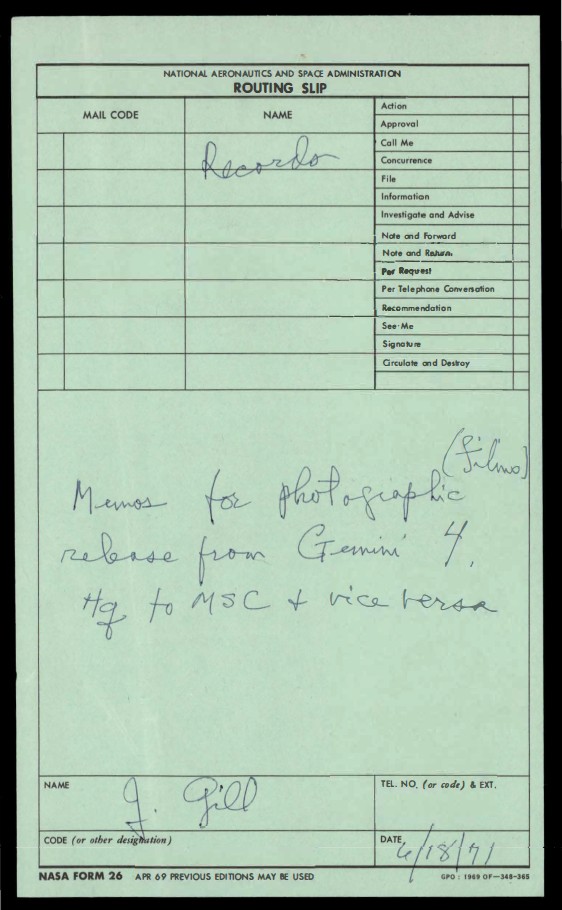
Gemini IV는 Gemini 시리즈의 두 번째 승무원 임무였습니다. 우주 비행사 James McDivitt와 Edward White는 1965년 6월 3일부터 6월 7일까지 4일간의 비행을 성공적으로 완료했습니다. 임무에는 미국 최초의 우주 유영이 포함되었습니다. 이 문서 모음에는 1967년 6월 25일경에 우주비행사가 우주선 외부의 밝은 입자를 관찰한 내용을 기록한 기록이 78~81페이지 및 101페이지에 포함되어 있습니다.
원문 (English) 보기
Gemini IV was the second crewed mission of the Gemini series. Astronauts James McDivitt and Edward White successfully completed the four-day flight between June 3 and June 7, 1965. The mission included the first American spacewalk. This collection of documents contains a transcription of the astronauts recounting their observations of bright particles outside the spacecraft, dated circa June 25, 1967, on pages 78-81, and page 101.
국립 항공 우주 행정관lo-1 라우팅 슬립 액션 우편번호 이름 승인 나에게 전화 동시 파일 정보 조사 및 조언 ____.l ,Nmote 및 전달 메모 및 R_e_hl_rn___ _ 나 _ __jL,P;;•• ,,-;R;:e::q::-u•=s�I::::.::_ ___ _ 전화당 하나의 대화 R..e,.c,추천 _ __J_ _: _ See·Me 서명 순환하고 De s I roy (fL 제이 1 '나, h'.C.9-- � 전화번호 NO · (또는 ode) & EXT. NASA 양식 2069년 4월 26일 이전 버전을 사용할 수 있습니다. 임무작전 보고 번호 M-913-65-04 각서 1965년 6월 1일 A/관리자에게 M/유인 우주 비행 부관리자로부터 제목: Gemini Flight Number Four(GT-4) 추가 비행 활동 GT-4 임무 작전 보고서 준비에 이어 여러 가지 새로운 절차와 장비 항목이 비행 단계로 진행되었습니다. 준비. 결과적으로 세 가지 중요한 추가 비행 활동은 다음과 같습니다. 이제 가능하며 임무에 포함되었습니다. 이러한 활동은 다음과 같습니다. 차량외 활동(EVA); 차량외 추진; 그리고 시연 부스터 2단계와의 만남. 이에 대한 추가 세부정보 비행 계획 활동은 기본 사항에 첨부된 보충 자료에 제공됩니다. 보고. 인클로저: MOR 번호 913-65-04 변경 1 내부 전용 M-913-65-04 추가 GT-4 비행 계획 활동 이제 세 가지 추가 특수 엔지니어링 및 운영 목표가 있습니다. GT-4 임무의 처음 4개 궤도에 대해 계획되었습니다. 1. 25피트를 이용한 차량외 활동(EVA) 시연 탯줄. 잠재적인 향후 적용에는 승무원 이동이 포함됩니다. 비행 수리, 궤도 물체 검사. 2. 간단한 것을 이용한 차량외 기동 시연 인간 추진 장치. 이 장치는 유무에 관계없이 사용할 수 있습니다. 미래 임무에 대한 우주선 밧줄. 3. 부스터 2단계와의 랑데뷰 시연. 이 활동은 귀중한 초기 정보와 기동성을 제공할 것입니다. 대상 차량과의 만남을 위해 필요한 절차. 깜박임 Gemini/Agena 차량용으로 설계된 조명과 동일한 조명 테스트를 위해 부스터 두 번째 단계에 설치되었습니다. 비행 계획 시퀀스에는 발사 후 분리가 포함됩니다. 그런 다음 우주선 분리 속도를 멈추기 위해 기동합니다. 는 처음 두 개의 궤도는 1보다 작은 거리에서 우주선과 함께 비행할 것입니다. 발사체로부터 4분의 1마일 떨어진 곳. 야간 별거는 깜박이는 불빛이 조종사의 시야를 어둡게 하는 것을 방지하기에 충분합니다. 적응. 첫 번째 궤도는 다음의 작동 점검으로 채워질 것입니다. 우주선 유도, 기동 및 환경 제어 시스템. 는 조종사는 두 번째 궤도를 활용하여 선외 활동을 준비하게 됩니다. 이 절차에는 25피트 배꼽을 풀고 조립하는 작업이 포함됩니다. 비상산소팩, 조종장치, 카메라 등을 갖추고 있다. 하와이 상공에서, 두 번째 궤도가 끝날 무렵 새벽에 객실의 압력이 감소됩니다. Jim McDivitt는 부스터 가까이로 이동합니다. 에 이 시점에서 오른쪽 해치가 열리고 Ed White가 밖으로 나와 내가 McDivitt가 그에게 명령을 내릴 때까지 우주선의 오른쪽 앞쪽 부분을 붙잡으세요. 해제 명령. 명령에 따라 White wi II는 천천히 밀어내고 방향을 바꿉니다. 휴대용 기동 유닛을 이용해 부스터를 향해 나아갑니다. 35mm 스틸 조종 장치에 장착된 카메라(Zeiss-Contarex)를 사용하여 사진을 촬영합니다. 다양한 지구/하늘 배경으로 부스터와 우주선을 그래프로 그려보세요. 이후 무중력 환경에서 자신의 기동 능력을 테스트하면서 White는 우주선과 진입을 향해 다시 기동합니다. 구분된 총 시간 우주선에서 약 10분 정도 소요됩니다. 그 사람은 안에 있을 거예요 우주선이 Ascension을 통과할 때 객실에 압력이 가해집니다. 세 번째 궤도가 시작되는 섬. Ascension을 통과한 직후 McDivitt가 부스터보다 앞서 움직일 것입니다. 초당 5피트의 분리 속도로. 이 기동은 부스터보다 더 높은 고도와 더 긴 주기의 궤도에 있는 우주선은 부스터 위로 올라가서 뒤로 넘어집니다. 한 궤도를 지나면 우주선이 65/6/1 페이지 1 M-913-65-04 부스터 뒤에서 16마일을 따라갑니다. 이 시점에서 우주선의 지연 초당 13피트의 기동으로 시각적 만남의 순서가 시작됩니다. 우주선은 뒤에서 그리고 아래에서 부스터에 접근합니다. 때문에 대기 밀도의 알려지지 않은 변화와 천천히 텀블링되는 항력 부스터를 사용하면 정확한 접근 궤적을 예측할 수 없습니다. 비행 승무원 부스터의 앙각을 측정하고 랑데뷰를 시작하겠습니다. 부스터가 위의 약 45도 앙각에 있을 때 기동합니다. 우주선. 부스터의 움직임을 관찰함으로써 별 배경과 우주선 관성 플랫폼 디스플레이와 관련하여 승무원은 측면 구성요소를 무효화하기 위한 적절한 측면 기동을 결정할 수 있습니다. 속도로 인해 직접적으로 우주선 속도 벡터가 발생합니다. 부스터쪽으로. 측면 속도 차이를 제거한 후 조종사는 전방 발사 스러스터를 사용하여 일련의 파괴 기동을 적용합니다. 닫히는 속도를 줄이세요. 승무원이 기내에서 측정합니다. 집결 절차에 필요한 전체 기동 속도를 계측합니다. 우주선은 발사체 가까이로 다시 돌아와야 합니다. 다섯 번째 궤도가 시작되는 남미의 북동쪽 해안. 랑데뷰 작업이 완료된 후 우주선은 다시 분리됩니다. 부스터에서 - 이번에는 Gemini를 배치하는 기동을 사용합니다. 예상 수명이 4일인 궤도에 있는 우주선. EVA 슈트는 사용된 G3C 슈트를 대체하는 새로운 G4C 슈트입니다. GT-3 비행 승무원에 의해 성공적으로 수행되었습니다. G4C 슈트에는 다음과 같은 새로운 기능이 있습니다. 특징: 가. 헬멧 - 시각, 열, 충격 및 미세 운석 보호. 비. 몸통 - 1. 증가된 구속 레이어에서 Nomex(HT-1) 11 Linknet11로 변경 구조 나 힘. 2. 밀봉 마개에 스트레인 릴리프 지퍼를 통합했습니다. 3. 재설계된 환기 입구 및 출구 피팅을 다음과 함께 통합합니다. 자동 잠금 및 이중 밀봉 기능. 4. Nomex(HT-1) 커버레이어를 통합 열 및 미 크로메테오리 타이 커버 레이어. 기음. 장갑 - 이동성과 마모성이 향상된 새로운 디자인 통합 저항 및 열 보호. 디. 바이오 커넥터 - 자체 정렬, 핀 보호 설계. 65/6/1 페이지 2 M-913-65-04 그림 1은 주요 신체 차이점 오래된 G3C 슈트 그리고 새로운 EVA G4C 슈트. 그림 2는 다음을 보여줍니다. 바이저 하나 내려놓고 새로운 G4C 헬멧, 실제로는 있다 감쇠 없음 난 들어갈 거야, 반면에 그림 3은 다음을 보여줍니다. 바이저 두 개와 함께 아래에는 눈에 띄는 차이 금액으로 안으로 들어오는 빛 우주비행사의 눈. 무화과. 세 번째 바이저로 아래로, 있을 거야 비슷한 감소세를 보일 것 금액으로 나는 들어갈 수 있어요 헬멧. 다양한 레이어 에 사용되는 재료의 EVA G4C 슈트 에 설명되어 있습니다 그림 4. G-4C 주의할 점은 오래된 오버 바이저 G3C 슈트 구성 공간 압력의 유일한 헬멧 및 구속층 그림 4의 HT -1 나일론 아우터 보호층. EVA 우주복 을 받았습니다 다음 자격 양이온 테스트: 65/6/1 페이지 3 • M-913-65-04 G-4C 감독관 공간 헬멧 그림. 3 G-4C 엑스트라 차량 슈트 열과 압력 그리고 초소형 유성체 구속 HH 나일론 OUITR 레이어 레이어 ~6~~ ㅜㅜ~~} ~~;:) 사용: 착용 및 태양 반사율 코튼 상수 "[AR ~응~~;:r~~m 옥스포드 NYLOt-i COf.JORT LAY.R 11 온스, 보 2 스와 PRCSSURE 레이어 ____ 네오프레~E 코테오 나일론 11-1·2ozvo21 r----- 구속 LAVlR 음( NH 데이크론 Al.;Q HflO~ 7개 레이어 ALUMINIZEO u-J 4oz vo 21 마일라(MYLAR) 7개의 레이카스 UNWOVEN DACRON 스페이서 HH 나일론 내부 마이크로,'tnOROID 스토퍼 레이어 !각 6. 8 OZ/YD2 흰색[사용: 착용 ANO MICR0~,1£TEO ROI D PRO TE CT ION 그림. 4 65/6/1 페이지 4 M-913-65-04 가. 누출 b. 내압 c. 02 호환성 디. 배출 봉투 이자형. 차가운 온도 에프. 급속 감압 g. 라이프 사이클링 h. 바이저 테스트 25피트 길이의 밧줄이 어떤 방식으로든 고장날 경우 조종사는 G4C 슈트 및 콘과 호환되는 체스트팩 주로 자동 밸브가 장착된 비상 산소통으로 구성됩니다. 주 비행 승무원과 예비 비행 승무원 모두가 해치가 열린 상태에서 40분간 객실 감압을 거쳤습니다. 세인트루이스 맥도넬 챔버에서 시뮬레이션된 고도 150,000피트 그 동안 그들은 해치를 열고 닫는 연습을 했다. 사진 및 EVA 중에 발생하는 기타 작업. 차량외 기동은 zero g Integral을 사용하여 수행됩니다. 그림 5와 같은 추진(ZIP) 장치. 이 장치는 휴대용이며 한 번의 전방 발사로 산소를 분사하여 추진력을 얻습니다. 노즐과 2개의 후방 발사 노즐은 작업자가 선택하고 조준합니다. 그것 편리한 차량 외부 사진 촬영을 위해 카메라가 장착되어 있습니다. 무화과. 5 65/6/1 페이지 5 임무작전 보고 번호 M-913-65-04 각서 1965년 5월 24일 A/관리자에게 M/유인 우주 비행 부관리자로부터 제목: 제미니 4번 비행편(GT-4) 12개의 Gemini 비행 시리즈 중 네 번째인 GT-4는 다음과 같이 예정되어 있습니다. 다음 날 또는 그 이후에 존 F. 케네디 우주 센터의 19단지에서 발사될 것입니다. 1965년 6월 3일. 이번 임무는 두 번째 유인 제미니 임무이자 가장 긴 임무이다. 2인 승무원이 시도한 적이 없습니다. 임무의 목적은 다음과 같습니다. 4일 동안 유인 우주 비행을 시연합니다. 공칭 출시 시간은 오전 10시(EDT)(1400GMT)입니다. 우주차량은 72도 방위각으로 발사되고 우주선은 11개 삽입될 것이다. 32.5도의 궤도 경사로 87-161 N.M.의 초기 궤도로 진입합니다. 62차 혁명 임무는 약 97시간과 50분 동안 진행됩니다. 분. 기본 및 백업 비행 승무원은 "신세대이며 11명은 두 번째 우주 비행사 그룹의 구성원. 제임스 A. 맥디비트(James A. McDivitt)가 될 것입니다. 지휘 조종사와 Edward H. White, II가 조종사가 될 것입니다. 지속시간이 있기 때문에 비행은 임무의 가장 중요한 측면 중 하나입니다. 비행 활동에는 비행 활동에 비해 확대된 의료 평가가 필요합니다. 회수 항공모함에 탑승한 최소 24시간을 포함한 이전 임무, USS WASP. 그동안 다양한 궤도 기동과 13가지 실험을 수행한 후 4일간의 임무, 우주선 Wi 11 재진입 및 착륙 약 400 수상 착륙 및 항공모함 회수를 위해 버뮤다에서 남서쪽으로 마일. 인클로저 모르누 M-913-65-04 내부 전용 신고번호 M-913-65-04 임무 운영 보고서 쌍둥이 자리 비행 번호 4 (GT-4) 유인 우주비행 사무국 내부 전용 머리말 임무 운영 보고서는 다음을 위해 명시적으로 출판됩니다. Administra의 요구에 따라 NASA 일반 관리 사용 1963년 8월 15일자 NASA 지침 6-2-10의 내용입니다. 푸르 이 보고서의 목적은 NASA 일반 관리에게 다음과 같은 정보를 제공하는 것입니다. 비행 임무 계획에 대한 시기적절하고 완전하며 결정적인 정보 Scout급 이상의 차량을 발사한 결과입니다. 각 비행 프로젝트에 대해 초기 보고서가 준비되고 발행됩니다. 출시 직전. 출시 후 각 보고서 업데이트 현재 일반 관리를 유지하기 위해 임무가 발행됩니다. NASA 지침 6-2-10에 제공된 대로 구성되었습니다. 이 보고서의 배포는 Gen이 특별히 지시했습니다. 일반적인 관리는 불가능하며 추가 또는 일반 관리에는 사용할 수 없습니다. 유통 . Pub I ic Affairs pub I ishes의 사무실은 포괄적인 내용을 담고 있습니다. NASA 비행 임무에 대한 일련의 발사 전 및 발사 후 보고서 일반 배포가 가능한 제품입니다. Pub I isec 및 Distributed 에 의해 프로그램 보고서 사무실 프로그래밍 사무실 국립 항공 및 우주 행정 워싱턴 DC 20546 M-913-65-04 일반 Gemini Flight Number Four(GT-4)가 두 번째입니다. Rtndczvous 지침 및 복구 시스템 ____ _, Gemini 프로그램의 유인 궤도 비행 및 11Ft 12편의 시리즈 중 네 번째 비행이 예정되어 있습니다. 장기간 및 랑데뷰 능력을 개발하고, 도킹 기술, 차량 외부 활동, 8피트 그리고 통제된 재진입. 처음 세 쌍둥이 자리 시연된 비행: 궤도 삽입 능력; 분리 지점 우주선의 구조적 무결성; 그리고 우주선 산화제 탱크 시스템 성능 및 승무원 숙소 •장비 베이 품질 각각. 이번 GT-4 미션은 유인 우주를 더욱 시연하기 위한 목적 27피트 4일간의 비행, 가장 긴 비행 두 명의 우주비행사가 비행한 적이 있다. 우주 차량 그림 1에 나와 있습니다. 11단계 엔진 추력실 임무 목표 기본 108피트 10 Ft • 성능을 시연하고 평가합니다. 한동안 제미니 우주선 시스템 4일이 넘었습니다. • 장기간 노출의 영향을 평가합니다. 2인용 우주환경으로 임무를 준비 중인 비행 승무원들 산화제 탱크 지속 시간이 길어졌습니다. 2차 • 역사격을 수행하는 OAMS 기능 시연 백업. • 우주선의 능력을 입증하고 비행 승무원은 비행기 내에서 중요한 일을 하고 비행기 밖에서의 기동. 1단계 엔진 g1mbal point • 우주선에 대한 추가 평가 수행 아래에 설명된 시스템: 1. 구조 및 열 보호 2. 환경 제어 시스템(ECS) •장비 베이에는 다음이 포함됩니다: 3. 승무원 스테이션 • 배터리· 4. 유도 및 제어 시스템 • 오작동 감지 시스템 IMOSI 장치 5. 궤도 자세 및 기동 시스템 • 사격장 안전 명령 제어 시스템 • 프로그래머(OAMS) • 3축 기준 시스템 !TARSI • 무선 유도 시스템 IRGSI • 자동 조종 장치 • 다음 실험을 실행합니다. • 계측 및 원격 측정 시스템 • D-1, 기본 사물 사진 촬영 그림. • D-6, 표면 사진 촬영 • D-8, 우주선의 방사선 • D-9, 간단한 탐색 • M-3, 기내 훈련 • M-4, 기내 심음파 검사 • M-6, 뼈 탈회 • MSC-1, 정전기 전하 65/5/24 페이지 1 M-913-65-04 • MSC-2, 양성자 전자 분광계 • MSC-3, 3축 자력계 • MSC-10, 2색 지구의 사지 사진 • S-5, 시놉틱 지형 사진 촬영 • S-6, 종합 기상 사진 촬영 이 임무의 특이한 임무 이 임무의 흥미로운 작업 중 하나는 비행 시간입니다. 그것 2인 팀이 진행하는 역대 최장 시간이 될 것입니다. 또 다른 고도로 흥미로운 점은 처음으로 미션을 제어할 수 있다는 것입니다. MCC(Mission Control Center) 휴스턴. 미션 컨트롤의 일부 요소 케이프 케네디 센터와 GSFC 컴퓨팅 시설은 다음과 같이 대기할 예정입니다. 시작 단계 중 백업. GSFC의 컴퓨팅 시설도 궤도 단계에서 MCC-Houston의 백업으로 사용됩니다. 비행 컨트롤러는 4교대로 24시간 내내 완전한 서비스를 제공하기 위해 MCC를 3교대로 운영합니다. 데이 미션.
원문 (English) 펼치기
NATIONAL AERONAUTICS AND SPACE ADMINISTRATlo-1 ROUTING SLIP Action MAIL CODE NAME Approval Call Me Concurrence file Information Investigate and Advise ____.l ,Nmote and Forward Note and R_e_hl_rn___ _ I _ __jL,P;;•• ,,-;R;:e::q::-u•=s�I::::.::_ ___ _ Per Teleph one Conversation R..e,.c,ommendation _ __J_ _: _ See·Me Signature Circulate and De s I roy (fL J 1 'I, h'.C.9-- � TEL. NO · (or ,ode) & EXT. NASA FORM 26 APR 69 PREVIOUS EDITIONS MAY BE USED Mission Operation Report No. M-913-65-04 MEMORANDUM June 1, 1965 To A/Administrator From M/Associate Administrator for Manned Space Flight Subject: Gemini Flight Number Four (GT-4) Additional Flight Activities Subsequent to the preparation of the GT-4 Mission Operation Report several new procedures and items of equipment have progressed to a stage of flight readiness. Consequently, three significant additional flight activities are now possible and have been included in the mission. These activities are: extra vehicular activities (EVA); extra vehicular propulsion; and demonstration of rendezvous with the booster second stage. Additional details of these flight plan activities are provided in the attached supplement to the basic report. Enclosure: MOR No. 913-65-04 Change 1 FOR INTERNAL USE ONLY M-913-65-04 ADDITIONAL GT-4 FLIGHT PLAN ACTIVITIES Three additional special engineering and operational objectives are now planned for the first four orbits of the GT-4 Mission: 1. Demonstration of extravehicular activities (EVA) using a 25 foot umbilical. Potential future application includes crew transfer, in flight repair, and inspection of orbiting objects. 2. Demonstration of extravehicular maneuvering using a simple, one man propulsion unit. This device could be used with or without a spacecraft tether on future missions. 3. Demonstration of rendezvous with the booster second stage. This activity wilI provide valuable early information and maneuvering procedures necessary to rendezvous with a target vehicle. Flashing lights identical to those designed for the Gemini/Agena Vehicle have been instaI led on the booster second stage for th is test. The Flight Plan sequence involves post-launch separation from the launch vehicle, then maneuvering to stop the spacecraft separation velocity. The first two orbits wilI be flown with the spacecraft at distances less than one quarter of a mile from the launch vehicle. Nighttime separation will be sufficient to prevent the flashing lights from disturbing the pilot's visual dark adaptation. The first orbit will be occupied with operational checks of the spacecraft guidance, maneuvering, and environmental control systems. The pilots will utilize the second orbit to prepare for the extravehicular activity. This procedure involves unstowing and assembling a 25-foot umbilical, the emergency oxygen pack, a maneuvering unit, and the cameras. Over Hawaii, at daybreak, near the end of the second orbit, the cabin will be depressurized and Jim McDivitt will maneuver to within close proximity of the booster. At this point, the right hatch will be opened and Ed White will climb out and hold on the right forward portion of the spacecraft unti I McDivitt gives him a release command. Upon command, White wi II push off slowly and reorient himself with the hand-held maneuvering unit to face the booster. A 35-mm still camera (Zeiss-Contarex) mounted on the maneuvering unit will be used to photo graph the booster and spacecraft with various earth/sky backgrounds. After testing his ability to maneuver in a zero gravity environment, White will maneuver back toward the spacecraft and ingress. The total time separated from the spacecraft will be approximately 10 minutes. He will be inside with the cabin repressurized by the time the spacecraft posses over Ascension Island on the start of the third orbit. Shortly ofter passing Ascension, McDivitt wil I maneuver ahead of the booster with 5 feet per second separation velocity. Because this maneuver places the spacecraft in a higher altitude and longer period orbit than the booster, it will rise above and fall behind the booster. One orbit later, the spacecraft 6/1/65 Page 1 M-913-65-04 will trail 16 miles behind the booster. At this point, a spacecraft retardation maneuver of 13 feet per second will initiate the visual rendezvous sequence. The spacecraft will approach the booster from behind and below. Because of unknown variation in the atmospheric density and drag of the slowly tumbling booster, the exact approach trajectory cannot be predicted. The flight crew will measure elevation angles of the booster and wil I initiate rendezvous maneuvers when the booster is approximately 45 degrees elevation angle above the spacecraft. By observing the movement of the booster with respect to the star background and with respect to the spacecraft inertial platform display, the crew can determine the proper lateral maneuver to null the lateral component of velocity thereby resulting in a spacecraft velocity vector which is directly toward the booster. After removing the lateral velocity difference, the pilot will apply a series of breaking maneuvers with the forward firing thrusters to reduce the closing velocity. The flight crew will measure with onboard instruments the total maneuvering velocity required for the rendezvous procedure. The spacecraft should be back in close proximity of the launch vehicle over the Northeast coast of South America at the beginning of the fifth orbit. After the rendezvous operation is complete, the spacecraft will again separate from the booster - this time using a maneuver which will place the Gemini spacecraft on an orbit with a predicted lifetime of four days. The EVA suit is the new G4C suit which replaces the G3C suit used so successfully by the GT-3 flight crew. The G4C suit has the following new features: a. Helmet - incorporation of triple lens shield (visors) for visual, thermal, impact, and micrometeorite protection. b. Torso - 1. Change to Nomex (HT-1) 11 Linknet11 in restraint layer for increased structure I strength. 2. Incorporation of strain relief zipper in sealing closure. 3. Incorporation of redesigned ventilation inlet and outlet fittings with automatic locking and redundant sealing features. 4. Replace Nomex (HT-1) coverlayer with integrated thermal and mi crometeori ty cover layer. c. Gloves - Incorporate new design with increased mobility, abrasion resistance and thermal protection. d. Bio-connector - Self-alighment, pin protective design. 6/1/65 Page 2 M-913-65-04 Figure 1 depicts the principal physical differences between the old G3C suit and the new EVA G4C suit. Figure 2 shows that with one visor down on the new G4C helmet, there is practi caI ly no attenutation of Ii ght entering, whereas Figure 3 shows that with two of the visors down there is a noticeable difference in the amount of light that enters the astronaut's eyes. FIG. With the third visor down, there would be a similar decrease in the amount of I ight al lowed to enter the helmet. The multivarious layers of materials used in the EVA G4C suits are delineated in Figure 4. It should G-4C be noted that the old OVER VISOR G3C suit consisted SPACE only of the pressure HELMET and restraint layers of Figure 4 with the HT -1 nylon outer protective layer. The EVA spacesuit has received the following qualifi cation tests: 6/1/65 Page 3 • M-913-65-04 G-4C OVERVISOR SPACE HELMET FIG. 3 G-4C EXTRAVEHICULAR SUIT THERMAL AND PRESSURE AND MICROMETEOROID RESTRAINT HH NYLON OUITR LAYERS LAYERS ~6~~ T~~~~~} ~~~;:) USE: WEAR AND SOLAR REFLECTANCE COTTON CONSTANT "[AR ~Ng~~;:r~~m OXFORD NYLOt-i COf.JORT LAY.R 11 oz,vo 2 swu PRCSSURE LAYER ____ NEOPRE~E COATEO NYLON 11-1·2ozvo21 r----- RESTRAINT lAVlR UM( NH DACRON Al.;Q HflO~ 7 LAYERS ALUMINIZEO u-J 4 oz vo 21 MYLAR SEPARATED BY 7 LAYCAS UNWOVEN DACRON SPACERS HH NYLON INNER MICROr,,'tnOROID STOPPER LAYERS !EACH 6. 8 OZ/YD2 WHIT[I USE: WEAR ANO MICR0~,1£TEO ROI D PRO TE CT ION FIG. 4 6/1/65 Page 4 M-913-65-04 a. Leakage b. Proof pressure c. 02 compatibility d. Ejection envelope e. Cold temperature f. Rapid decompression g. Life cycling h. Visor testing Should the 25-foot long tether fail in some manner, the pilot will be carrying a chestpack that has been compatibility qualified with the G4C suit and con sists principally of an emergency oxygen bottle with automatic valving. It should be emphasized that both the primary and backup flight crews have undergone 40 minutes cabin depressurization with the hatches open at a simulated altitude of 150,000 feet in the chambers at McDonnell, St. Louis during which time they practiced opening and closing the hatches, taking pictures, and other actions that will take place during EVA. The extravehicular maneuvering will be accomplished using a zero g Integral Propulsion (ZIP) Unit as shown in Figure 5. This device is handheld and accomplishes propulsion by jetting oxygen out through a single forward firing nozzle and two aft firing nozzles as selected and aimed by the operator. It includes a camera mounted for convenient extravehicular photography. FIG. 5 6/1/65 Page 5 Mission Operation Report No. M-913-65-04 MEMORANDUM May 24, 1965 To A/Administrator From M/Associate Administrator for Manned Space Flight Subject: Gemini Flight Number Four (GT-4) GT-4, the fourth in a series of twelve planned Gemini flights is scheduled to be launched from Complex 19 at the John F. Kennedy Space Center on or after 3 June 1965. This wi 11 be the second manned Gemini mission and the longest ever attempted by a two-man crew. The purpose of the mission is to further demonstrate manned space flight for a period of four days. The nominal launch time is 10 a.m. EDT (1400 GMT). The space vehicle is to be launched on an azimuth of 72 degrees and the spacecraft wi 11 be inserted into an initial orbit of 87-161 N.M. at an orbital inclination of 32.5 degrees. The 62 revolution mission will have a duration of approximately 97 hours and 50 minutes. The primary and backup flight crews are of the "new generation, 11 being members of the second group of astronauts. James A. McDivitt will be the command pilot and Edward H. White, II will be the pilot. Because the duration of the flight is one of the most significant aspects of their mission, the post- flight activities will involve expanded medical evaluation as compared with previous missions, including at least 24 hours aboard the recovery aircraft carrier, the USS WASP. After conducting various orbital maneuvers and the thirteen experiments during the four-day mission, the spacecraft wi 11 reenter and touchdown approximately 400 miles southwest of Bermuda for a water landing and carrier retrieval. Enclosure MOR Noo M-913-65-04 FOR INTERNAL USE ONLY Report No. M-913-65-04 MISSION OPERATION REPORT GEMINI FLIGHT NUMBER FOUR (GT-4) OFFICE OF MANNED SPACE FLIGHT FOR INTERNAL USE ONLY FOREWORD MISSION OPERATION REPORTS are published expressly for the use of NASA General Management as required by the Administra tor in NASA Instruction 6-2-10 dated August 15, 1963 . The pur pose of these reports is to provide NASA General Management with timely, complete and definitive information on flight mission plans and results from launchings with Scout class or larger vehicles. Initial reports are to be prepared and issued for each flight project just prior to launch. Following launch, updating reports for each mission will be issued to keep General Management currently in formed as provided in NASA Instruction 6-2-10. Distribution of these reports has been specifically directed by Gen eral Management and they are not available for additional or general distribution . The Office of Pub I ic Affairs pub I ishes a comprehensive series of pre-launch and post-launch reports on NASA flight missions which are available for general distribution. Pub I ishec and Distributed by OFFICE OF PROGRAM REPORTS OFFICE OF PROGRAMMING NATIONAL AERONAUTICS AND SPACE ADMINISTRATION Washington, D. C. 20546 M-913-65-04 GENERAL Gemini Flight Number Four (GT-4) is the second Rtndczvous guidance & recovery system ____ _, manned orbital flight in the Gemini Program and 11 Ft the fourth flight in a series of twelve planned to develop long-duration and rendezvous capability, docking techniques, extra-vehicular activities, 8 Ft and controlled reentry. The first three Gemini flights demonstrated: orbital insertion capability; Separation point spacecraft structural integrity; and spacecraft Oxidizer tank systems performance and crew accommodation •Equipment bay qualities, respectively. This GT-4 mission is intended to further demonstrate manned space 27 Ft flight for a period of four days, the longest ever flown by two astronauts. The space vehicle is depicted in Figure 1. Stage 11 engine thrust chamber MISSION OBJECTIVES PRIMARY 108 Ft 10 Ft • Demonstrate and evaluate the performance of the Gemini spacecraft systems for a period exceeding four days. • Evaluate the effects of prolonged exposure to the space environment on the two-man flight crew in preparation for missions of Oxidizer tank longer duration. SECONDARY • Demonstrate OAMS capability to perform retro fire backup. • Demonstrate the capability of the spacecraft and flight crew to make significant in-plane and out-of-plane maneuvers. Stage I engine g1mbal point • Conduct further evaluation of spacecraft systems as outlined below: 1. Structure and thermo I protection 2. Environmental Control Systems (ECS) •Equipment bay contains: 3. Crew stations • Batteries· 4. Guidance and Control System • Malfunction detection system IMOSI units 5. Orbital Attitude and Maneuver System • Range safety command control system • Programmer (OAMS) • Three-axis reference system !TARSI • Radio guidance system IRGSI • Autopilot • Execute the fol Io wing experiments: • Instrumentation and telemetry system • D-1, Basic Object Photography FIG. • D-6, Surface Photography • D-8, Radiation in Spacecraft • D-9, Simple Navigation • M-3, In-Flight Exercises • M-4, In-Flight Phonocardiogram • M-6, Bone Demineralization • MSC-1, Electrostatic Charge 5/24/65 Page 1 M-913-65-04 • MSC-2, Proton Electron Spectrometer • MSC-3, Tri-Axis Magnetometer • MSC-10, Two-Color Earth's Limb Photos • S-5, Synoptic Terrain Photography • S-6, Synoptic Weather Photography UNUSUAL TASKS OF THIS MISSION One of the interesting tasks of this mission is the duration of the flight. It will be the longest ever to be conducted by a two-man crew. Another highly interesting item is that control of the mission for the first time wil I be from the Mission Control Center (MCC) Houston. Some elements of the Mission Control Center at Cape Kennedy and the GSFC computing facility will be standing by as a backup during the launch phase. The computing facilities at GSFC will also be used as a backup to MCC-Houston during the orbital phase. Flight controllers will man the MCC in three shifts to give complete round-the-clock coverage of the four day mission.