CIA-UAP-015, Project Blue Book Special Report No. 14 (Analysis of Reports of Unidentified Aerial Objects)
원문 (English) 보기
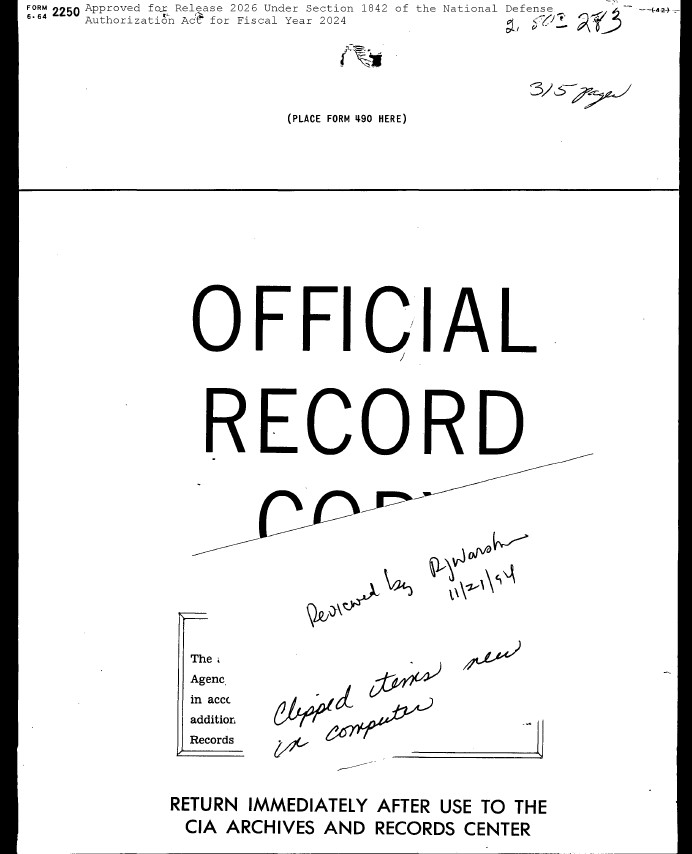
This is the USAF Project Blue Book with a CIA cover sheet stating the document is "Official Record Copy." With the exception of the handwritten note on the first page, the content of this document has been available on CIA's public website.
--~.~..:_:._~,. / 양식 2250 승인됨: 국가방위법 1842항에 따라 2026년 릴리스~5.e ,..,_ _.,-<,y-; ~ -- --<-4시간~ 6 • 64 2024 회계연도에 대한 Authorizati6n Ac1- e' ~ 5'f.J _: ~- _,.,/ 1 (여기에 양식을 작성하세요) 0 FFI C/IAL 제이 기록 는, 대리점 acc에. 추가자, 기록 .,.---------- 사용 후 즉시 반환하십시오. CIA 기록 보관소 및 기록 센터 2250 양식 6-64 (여기에 ~90 양식을 작성하세요.} 공식 제이 기록 복사 경고 첨부된 문서는 안전하게 보호되어야 합니다. 그것은 기관의 공식 역사적 기록이며 보존되어야 합니다. 1950년 연방 기록법에 따라. 추가 정보는 CIA 기록 보관소 국장에게 전화하고 기록 센터, 내선번호 2468. 사용 후 즉시 반환하십시오. CIA 기록 보관소 및 기록 센터 -:/). 나 - ,1/i . . . r ..~.. ,=,. __._,_- . :~ ·, ••,;-.,-·, C / , ' \ .- _.," _ :.---_J: -~,,,, , -,_1: ... ~ - ~- ·~f·;•";,_,, ;: ~;..::;s.-..:.--:;_1-:,:,•-'l(<..., --... ~·-....... ---_,,,!,.,,,,.,._ ,._;· ㄷ~ '.'. :'.: ?'e·~--·(-'· ·~,-- I Bj/ ) • I 'PROJECT BLL~~Il t!'L ··21u,c< ,.,.. # ·, • 1. ."""- 티?0 d'" ; 1---7SJ 나'/~ 나 특별 보고서 N0.14 II 나 (미확인 공중 물체 보고 분석) 나 나 프로젝트 번호 10073 나 1955년 5월 5일 \ 나 나 나 나 .I 나 항공기술정보센터 라이트-패터슨 공군기지 나 오하이오 나 나 35 번호 복사 --------- ,, 내가 프로젝트 블루북 \나 특별보고서 No. 14 ' ii (미확인 공중 물체 보고 분석) 나1엘 나 나 나 프로젝트 번호 10073 나 :1 1955년 5월 5일 나 1 11 ! ii 공식적으로만! (AFR 190-16) 나 :나는 !1 나 나 I 항공 기술 정보 젠터 라이트-패터슨 공군기지 오:월 나 나 이 간행물에는 저작권 자료가 포함되어 있지 않습니다. _나 나 나 목차 나 요약. vii 나 소개 데이터의 출처와 성격 3 나 데이터를 기계화된 계산 양식 4로 축소 설문지 . 4 I 코딩 시스템 및 워크시트 6 작업 문서의 식별. 7 개별 보고서의 평가 10 나는 데이터를 분석합니다. 14 특성별 빈도 및 백분율 분포 14 그래픽 프리젠테이션 . 16 I 데이터의 고급 연구 16 관찰자에 대한 태양의 위치 16 통계적 카이제곱 검정 60 "비행접시" 모델 76 나 결론 94 부록 A. 빈도 및 백분율 표 I 특성별 분포 95 부록 B. 작업 서류 양식 255 I 일러스트레이션 목록 그림 l 물체, 유닛, 전체 목격에 대한 연도별 목격 빈도 17 그림 2 모든 연도의 물체, 단위, 모든 목격에 대한 평가 분포 18 나 그림 3 비교를 통해 모든 연도에 대한 평가에 따른 물체 관찰 분포 각 평가그룹별 연도별 • 19 나 그림 4 모든 연도 및 20년마다 평가에 따른 물체 관찰 분포 그림 5 모든 연도에 걸쳐 수개월 내 평가에 따른 물체 관찰 분포 21 나 그림 6 물체 관찰의 확실성과 의심스러운 평가에 따른 분포 모든 연도 및 각 연도 • 22 그림 7 물체 목격 빈도 및 알 수 없는 물체 평가 I 달, 1947-1952. 23 그림 8 관측 신뢰도 그룹에 따른 물체 관측 분포 각 그룹의 평가 분포. 24 나 그림 9 네 가지 관측 신뢰도 중 물체 관측의 분포 모든 연도 및 각 연도에 대한 그룹입니다. 25 I 그림 10 관측 신뢰도 그룹에 따른 모든 목격의 분포, 분리 군사 및 민간 관찰자에 의한 평가 배포 각 분리에 대해 26 I 그림 11 보고된 물체 색상에 따른 물체 관찰 분포 색상군별 평가 분포 • 27 그림 12 관찰당 목격된 물체 수에 따른 물체 관찰 분포 I 각 그룹에 대한 평가 분포 포함 28 그림 13 평가를 통한 관찰 기간별 물체 관찰 분포 각 기간 그룹에 대한 분포. 29 나 나 iii 나 나 나 일러스트레이션 목록 (계속) 나는 페이지 나 그림 14 8개 기간 중 월별 물체 목격 분포 30년 전체 그룹 그림 15 보고된 물체의 모양에 따른 물체 관찰 분포 각 형태 그룹에 대한 평가 분포, 31 I 그림 16 보고된 물체 속도에 따른 물체 관찰 분포 각 속도 그룹에 대한 평가 분포 . 32 나 그림 17 모든 연도 및 각 연도에 관찰자 위치별 모든 목격 분포 33 그림 18 색상별 알려진 물체 목격과 알려지지 않은 물체 목격 비교, 1947-1952 34 나 그림 19 물체 수에 따른 알려진 물체 관찰과 알려지지 않은 물체 목격의 비교 목격 당, 1947-1952 35 그림 20 속도에 따른 알려진 물체 목격과 알려지지 않은 물체 목격의 비교, 1947-1952 36 I 그림 21 1947년부터 1952년까지 기간별 알려진 물체 목격과 알려지지 않은 물체 목격의 비교 37 그림 22 1947-1952년 형태별 알려진 물체 목격과 알려지지 않은 물체 목격의 비교 38 I 그림 23 1947년부터 1952년까지 빛의 밝기에 따른 알려진 물체 목격과 알려지지 않은 물체 목격의 비교 39 그림 24 천문학적으로 평가된 물체 목격의 월별 분포 비교 나 전체 물체 목격과 비교하여 천문학적이지 않습니다. 40 그림 25 항공기로 평가된 물체 목격의 월간 분포 비교 총 물체 목격 횟수와 항공기 감소 비교 41 나 그림 26 풍선으로 평가된 물체 목격의 월간 분포 비교 총 물체 관찰 대 풍선 감소, 42 나 그림 27 미흡하다고 평가된 물체 관찰의 월간 분포 비교 정보 대 전체 물체 목격 정보가 덜 불충분함 43 그림 28 기타로 평가된 물체 목격의 월간 분포 비교 총 물체 목격 건수 대비 기타 44 I 그림 29 미확인으로 평가된 물체 목격의 월간 분포 비교 전체 물체 목격 건수 대비 덜 알려지지 않음 45 그림 30 전체 샘플, 알려진 평가에 따른 물체 관찰의 특성 프로필 및 개별 알려진 평가(알려지지 않은 평가가 중첩됨), 46 그림 31 1947~1952년 미국 내 물체, 단위 및 모든 목격 빈도, I 저 위도와 경도의 1도 구분 47 그림 32 12개 지역 평가에 따른 물체 관찰 분포 미국, 전략지역이 위치한 곳 48 I 그림 33 전략 지역의 물체 관찰 평가 비교 중부동부지역 49 나 그림 34 전략 지역의 물체 관찰 평가 비교 중서부 지역 50 그림 35 전략 지역의 물체 관찰 평가 비교 중서부 지역 51 I 그림 36 전략 지역의 물체 관찰 평가 비교 중남부 지역. 52 나 그림 37 전략 지역의 물체 관찰 평가 비교 남서부 지역 53 나 나 iv 나 나 나 나 일러스트레이션 목록 (계속) 나 그림 38 전략 지역의 물체 관찰 평가 비교 사우스 극서부 지역. 54 나 그림 39 천구의 다이어그램. 56 그림 40 태양 고도각, 간격에 따른 물체 관찰 빈도 10도 각도. 57 나 그림 41 현지 태양 시간별 물체 관찰 빈도, 1시간 간격 59 테이블 물체 목격 60 나 표 II 색상 62를 기준으로 알려진 값과 알려지지 않은 값의 카이 제곱 테스트 표 III 숫자 63을 기반으로 한 알려진 값과 알려지지 않은 값의 카이 제곱 테스트 나 표 IV 형태 64를 기반으로 한 알려진 값과 알려지지 않은 값의 카이 제곱 테스트 표 V 관측 기간을 기준으로 알려진 값과 알려지지 않은 값의 카이 제곱 검정 65 나 표 VI 속도를 기준으로 알려진 값과 알려지지 않은 값의 카이 제곱 테스트 ti6 표 VII 빛의 밝기에 기초한 알려진 값과 알려지지 않은 값의 카이 제곱 테스트 67 나 표 VIII 색상 70을 기준으로 수정된 알려진 값과 알려지지 않은 값의 카이 제곱 테스트 표 IX 숫자를 기준으로 수정된 알려진 값과 알려지지 않은 값의 카이 제곱 검정. 71 나 표 X 모양 72를 기준으로 수정된 알려진 값과 알려지지 않은 값의 카이 제곱 테스트 표 XI 다음을 기반으로 수정된 알려진 값과 알려지지 않은 값의 카이 제곱 검정 I 관찰 기간 73 표 XII 속도 74를 기준으로 수정된 알려진 값과 알려지지 않은 값의 카이 제곱 테스트 표 XIII 빛의 밝기를 기준으로 수정된 알려진 값과 알려지지 않은 값의 카이 제곱 테스트. 75 나 나 나 나 나 나 나 나 나 v와 vi 나 나 나 요약 나 미확인 공중 물체에 대한 보고(일반적으로 "비행"이라고 함) 접시"또는 "비행 디스크")가 미 공군에 의해 접수되었습니다. 나 1947년 중반 이후로 수많은 다양한 출처로부터. 없었지만 미확인 물체에 대한 설명할 수 없는 보고가 구성되었다는 증거 미국의 안보에 위협이 된다고 공군은 판단했다. 나 미식별 공중 물체의 대표자는 적발하고 평가해야 합니다. "비행 접시"인지 결정합니다. 기술 발전을 대표하는 이 나라에는 알려지지 않았습니다. 나 어떤 관련 경향이나 패턴에 내재되어 있는지 발견하기 위해 데이터를 수집하고 발견된 추세나 패턴을 적절하게 평가하거나 설명합니다. I 미식별 공중 물체 보고에서 이러한 데이터를 줄이는 방법 과학적 평가가 가능한 형태로 채택되었다. 일반적으로, 이 연구의 기반이 된 원본 데이터는 인상과 나는 명백히 설명할 수 없는 사건을 해석하고 거의 포함하지 않습니다. 물리적 특성에 대한 신뢰할 수 있는 측정. 이 데이터의 주관성은 중요한 결론을 도출하는 데에는 '중요한 한계'를 제시했지만 나는 연구에서 과학적 방법의 적용을 무효화하지 않았습니다. 미확인 공중에 대한 미 공군의 보고 I 개체는 다음과 같은 방법을 통해 IBM 천공 카드 데이터 요약으로 축소되었습니다. 논리적으로 개발된 형식과 표준화된 평가 절차로 구성됩니다. 데이터 준비의 중요한 단계인 목격 보고서 평가 나는 통계처리를 위해 보고서에 대한 평가와 각 보고서에 설명된 개체의 후속 분류. 연구의 이 단계에 대한 자세한 설명은 주의 깊은 점을 강조합니다. 나 완전한 객관성과 일관성을 유지하려고 노력합니다. 원본에서 도출된 정제되고 평가된 데이터 분석 나 목격에 대한 보고는 (I) 어떤 것을 찾아내려는 체계적인 시도로 구성되었습니다. 특정 세그먼트의 데이터에 내재된 고유한 특징, (2) 발견된 경향이나 패턴에 대한 집중적인 연구, (3) 시도 나 UNKNOWNS 중 하나가 관측값을 나타낼 확률을 결정합니다.:. 이 나라에는 알려지지 않은 기술 발전에 대한 이야기입니다. 나 '데이터 분석'의 첫 번째 단계에서는 다음과 같은 존재가 드러났습니다. 확실히 식별된 개체 사이의 특정 명백한 유사성 .i.식별되지 않은 항목을 찾아보세요. 적용 시 통계적 테스트 방법 표시 나 이러한 명백한 유사성이 중요할 확률은 낮습니다. 안 UNKNOWNS 중 하나가 재현될 확률을 결정하려고 시도합니다. 이 나라에 알려지지 않은 기술 발전에 대한 관찰이 필요합니다. 나 대상이 아닌 경우에 대해 철저한 재검토 및 재평가를 실시함 원래 식별됨; 이로 인해 이 확률이 매우 높다는 결론이 나왔습니다. 작다. 나 이 보고서의 결과로 나온 특별 연구(보고서 분석) 미확인 공중 물체(1955년 5월 5일)는 1953년에 시작되었습니다. 나 완전한 파일 세트를 갖춘 스터디 그룹의 정보~ 마감 날짜는 다음과 같습니다. 1952년 말에 설립되었습니다. 이 보고서의 모든 차트와 표에 포함된 통계가 종료됩니다. 나 vii !나 나 나 나 1952년입니다. 이 차트에서는 3201개의 사례가 사용되었습니다. 나 연구가 진행됨에 따라 지속적인 프로그램이 유지되었습니다. 현재 접수된 사건을 비교하는 목적 1953년 1월 이후 보고서에 사용된 것들. 이 일은 끝났다 이로 인해 발생할 수 있는 모든 변화나 중요한 추세가 현재 진행 상황은 이 보고서 요약에 포함될 수 있습니다. 나 1953년과 1954년의 사례는 일반적이고 예상되는 경향을 보여줍니다. 최종적으로 식별된 카테고리의 비율이 증가합니다. 그들도.show 나 정보가 부족한 카테고리의 비율 감소 현상과 설명할 수 없는 현상. 이러한 추세는 되었습니다:. 개선된 보고 및 조사에 비추어 예상됨 ceduJ;"es. 1954년 말 현재 보유하고 있는 공식 보고서는 총 4,834개입니다. 425는 1953년에, 429는 195'!에 생산되었습니다. 이 1953년과 1954년 인디 개별보고서(총 854건)는 과 동일한 기준으로 평가되었습니다. 1952년 말 이전에 받은 것. 결과는 다음과 같습니다. 나 풍선 - 16% 나 항공기 - 20% 천문학적 - 25% I 기타 - 13% 1. 정보가 부족함 1 7% - 알 수 없음 9% I 현재 사례에 대한 연구가 진행됨에 따라 점점 더 많아졌습니다. 보고 및 조사 절차가 더욱 개선될 수 있다면, 나는 정보가 불충분한 사례의 비율 설명되지 않은 나머지 부분은 크게 줄어들 것입니다. 더 높은 곳으로 가는 열쇠 솔루션의 비율이 신속한 "현장" 조사에 있는 것으로 나타났습니다. 나 훈련받은 직원에 의해. 이를 토대로 개정된 프로그램이 수립됐다. AF Reg. 200-2 제목: "미확인 비행물체 보고" (짧은 제목: UFOB) 1954년 8월 12일자. I 이전부터 눈에 띄는 결과를 보여주기 시작한 이 새로운 프로그램은 1955년 1월, 주로 4602d 항공 정보국' 나 Squadron(방공사령부)은 모든 현장 조사를 수행합니다. 이 편대는 충분한 부대를 보유하고 있으며 도착할 수 있을 정도로 배치되어 있습니다. 신고 접수 후 매우 짧은 시간 내에 "현장에서". 이후 나 4602d AISS에 의한 처리, 모든 정보는 Air Technical에 제공됩니다. 최종 평가를 위한 정보 센터. 이 협력 프로그램은 다시 1955년 1월 1일부터 정보 부족 사례를 줄이기 위해 노력했습니다. 나 7o/o로, 알 수 없는 사례는 전체의 3%입니다. 1955년 1월 1일부터 1955년 5월 5일까지의 기간 동안 131명의 신원이 밝혀지지 않았습니다. 나 공중 물체 보고가 접수되었습니다. 이에 대한 평가 비율은 다음과 같습니다. 나 viii 나 나 나 풍선 - 26% -II 항공기 - 21% ..... I 천문학적 - 23% 나 기타 20% 정보 부족 - 7% ,, 나는 모른다 - 3% 이용 가능한 모든 데이터가 본 연구에 포함되었습니다. 저는 공군 안팎의 과학자들로 구성된 패널입니다. 이를 토대로 연구에 따르면 모든 미확인 공중 물체는 좀 더 완전한 관측 데이터가 있었다면 설명했습니다. 지금까지 만약에 아직 설명되지 않은 채로 보고된 공중 물체에 관해서는, 인상과 해석 외에는 정보가 거의 없습니다. 그들의 관찰자 중. 이러한 인상과 해석은 나는 개선된 조사 및 보고 방법의 사용으로 대체했으며, ,과학적 분석에 따르면, 설명되지 않는 사례의 수가 급격히 감소했습니다. 나 소실점을 향해. 따라서 이러한 정보 평가를 바탕으로 다음과 같습니다. r·안녕하세요
원문 (English) 펼치기
----~.~..:_:._~,. / FORM 2250 Approved fo..r: Release 2026 Under Section 1842 of the National Defen~5.e ,..,_ _.,-<,y-; ~ -- --<-4H~ 6 • 64 Authorizati6n Ac1- e' for Fiscal Year 2024 ~ 5'f.J _: ~- _,.,/ 1 (PLACE FORM qgo HERE) 0 FFI C/IAL J RECORD The, Agenc. in accc. additior, Records .,.---------- RETURN IMMEDIATELY AFTER USE TO THE CIA ARCHIVES AND RECORDS CENTER 2250 FORM 6-64 (PLACE FORM ~90 HERE} OFFICIAL J RECORD COPY WARNING The attached document (s) must be safeguarded. It is the Agency's Official Historical Record and must be preserved in accordance with the Federal Records Act of 1950. For additional information, call the Chief, CIA Archives and Records Center, extension 2468. RETURN IMMEDIATELY AFTER USE TO THE CIA ARCHIVES AND RECORDS CENTER -:/). I - ,1/i . . . r ..~.. ,=,. _._,_- . :~ ·, ••,;-.,-·, C / , ' \ .- _.," _ :.---_J: -~,,,, , -,_1: ... ~ - ~- ·~f·;•";,_,, ;: ~;..::;s.-..:.--:;_1-:,:,,•-'l(<..., --... ~·-....... --..._,,,!,.,,,,.,._ ,._;· C~ '.'. :'.: ?'e·~--·(-'· ·~,-- I Bj/ ) • I 'PROJECT BLL~~Il t!'L ·•21u,c< ,.,.. # ·, • 1. ."""- ti?0 d'" ; 1---7 SJ I '/~ I SPECIAL REPORT N0.14 II I (ANALYSIS OF REPORTS OF UNIDENTIFIED AERIAL OB1ECTS) I I PROJECT NO. 10073 I I 5 MAY 1955 \ I I I I .I I AIR TECHNICAL INTELLIGENCE CENTER WRIGHT-PATTERSON AIR FORCE BASE I OHIO I I 35 Copy No. --=---- ,, l PROJECT BLUE BOOK \I SPECIAL REPORT NO. 14 ' ii (ANALYSIS OF REPORTS OF UNIDENTIFIED AERIAL OBJECTS) i1 l I I I PROJECT NO. 10073 I :1 5 MAY 1955 I 1 11 ! ii FOR OffIC!Al USt ONlY (AFR 190-16) I :I !1 I I I AIR TECHNICAL INTELLIGENCE GENTER WRIGHT-PATTERSON AIR FORCE BASE o:mo I I No copyright materiel ls contained In this publication, _I I I TABLE OF CONTENTS I SUMMARY. vii I INTRODUCTION ORIGIN AND NATURE OF DATA 3 I REDUCTION OF DATA TO MECHANIZED COMPUTATION FORM 4 Questionnaire . 4 I Coding System and Work Sheet 6 Identification of Working Papers. 7 Evaluation of Individual Reports 10 I ANALYSIS OF THE DATA. 14 Frequency and Percentage Distributions by Characteristics 14 Graphical Presentation . 16 I Advanced Study of the Data 16 Position of the Sun Relative to the Observer 16 Statistical Chi Square Test 60 The "Flying Saucer" Model 76 I CONCLUSIONS 94 APPENDIX A. TABULATION OF FREQUENCY AND PERCENTAGE I DISTRIBUTIONS BY CHARACTERISTICS 95 APPENDIX B. WORKING PAPER FORMS 255 I LIST OF ILLUSTRATIONS Figure l Frequency of Sightings by Year for Object, Unit, and All Sightings 17 Figure 2 Distribution of Evaluations of Object, Unit, and All Sightings for All Years 18 I Figure 3 Distribution of Object Sightings by Evaluation for All Years With Comparisons of Each Year for Each Evaluation Group • 19 I Figure 4 Distribution of Object Sightings by Evaluation for All Years and Each Year 20 Figure 5 Distribution of Object Sightings by Evaluation Within Months for All Years 21 I Figure 6 Distribution of Object Sightings by Certain and Doubtful Evaluations for All Years and Each Year • 22 Figure 7 Frequency of Object Sightings and Unknown Object Evaluations by I Months, 1947-1952. 23 Figure 8 Distribution of Object Sightings by Sighting Reliability Groups With Evaluation Distributions for Each Group . 24 I Figure 9 Distribution of Object Sightings Among the Four Sighting Reliability Groups for All Years and Each Year . 25 I Figure 10 Distribution of All Sightings by Sighting Reliability Groups, Segregated by Military and Civilian Observers, With Evaluation Distribution for Each Segregation 26 I Figure 11 Distribution of Object Sightings by Reported Colors of Object(s) With Evaluation Distribution for Each Color Group • 27 Figure 12 Distribution of Object Sightings by Number of Objects Seen per Sighting I With Evaluation Distribution for Each Group 28 Figure 13 Distribution of Object Sightings by Duration of Sighting With Evaluation Distribution for Each Duration Group . 29 I I iii I I I LIST OF ILLUSTRATIONS (Continued) I Page I Figure 14 Distribution of Object Sightings by Months Among the Eight Duration Groups for All Years 30 Figure 15 Distribution of Object Sightings by Shape of Object(s) Reported With Evaluation Distribution for Each Shape Group , 31 I Figure 16 Distribution of Object Sightings by Reported Speed of Object(s) With Evaluation Distribution for Each Speed Group . 32 I Figure 17 Distribution of All Sightings by Observer Location for All Years and Each Year 33 Figure 18 Comparison of Known and Unknown Object Sightings by Color, 1947-1952 34 I Figure 19 Comparison of Known and Unknown Object Sightings by Number of Objects per Sighting, 1947-1952 35 Figure 20 Comparison of Known and Unknown Object Sightings by Speed, 1947-1952 36 I Figure 21 Comparison of Known and Unknown Object Sightings by Duration, 1947-1952 37 Figure 22 Comparison of Known and Unknown Object Sightings by Shape, 1947-1952 38 I Figure 23 Comparison of Known and Unknown Object Sightings by Light Brightness, 1947-1952 39 Figure 24 Comparison of Monthly Distribution of Object Sightings Evaluated as Astronomical I Versus Total Object Sightings Less Astronomical. 40 Figure 25 Comparison of Monthly Distribution of Object Sightings Evaluated as Aircraft Versus Total Object Sightings Less Aircraft 41 I Figure 26 Comparison of Monthly Distribution of Object Sightings Evaluated as Balloon Versus Total Object Sightings Less Balloon, 42 I Figure 27 Comparison of Monthly Distribution of Object Sightings Evaluated as Insufficient Information Versus Total Object Sightings Less Insufficient Information 43 Figure 28 Comparison of Monthly Distribution of Object Sightings Evaluated as Other Versus Total Object Sightings Less Other 44 I Figure 29 Comparison of Monthly Distribution of Object Sightings Evaluated as Unknown Versus Total Object Sightings Less Unknown 45 Figure 30 Characteristics Profiles of Object Sightings by Total Sample, Known Evaluations, ,- and Individual Known Evaluations, With Unknown Evaluations Superimposed , 46 Figure 31 Frequency of Object, Unit, and All Sightings Within the U. S., 1947-1952, by I Subdivisions of One Degree of Latitude and Longitude 47 Figure 32 Distribution of Object Sightings by Evaluation for the Twelve Regional Areas of the U. S., With the Strategic Areas Located 48 I Figure 33 Comparison of Evaluation of Object Sightings in the Strategic Areas of the Central East Region 49 I Figure 34 Comparison of Evaluation of Object Sightings in the Strategic Areas of the Central Midwest Region 50 Figure 35 Comparison of Evaluation of Object Sightings in the Strategic Areas of the Central Farwest Region 51 I Figure 36 Comparison of Evaluation of Object Sightings in the Strategic Areas of the South Midwest Region . 52 I Figure 37 Comparison of Evaluation of Object Sightings in the Strategic Areas of the South West Region 53 I I iv I I I I LIST OF ILLUSTRATIONS (Continued) I Figure 38 Comparison of Evaluation of Object Sightings in the Strategic Areas of the South Farwest Region . 54 I Figure 39 Diagram of a Celestial Sphere. 56 Figure 40 Frequency of Object Sightings by Angle of Elevation of the Sun, Intervals of 10 Degrees of Angle. 57 I Figure 41 Frequency of Object Sightings by Local Sun Time, Intervals of One Hour 59 Table Object Sightings 60 I Table II Chi Square Test of Knowns Versus Unknowns on the Basis of Color 62 Table III Chi Square Test of Knowns Versus Unknowns on the Basis of Number 63 I Table IV Chi Square Test of Knowns Versus Unknowns on the Basis of Shape 64 Table V Chi Square Test of Knowns Versus Unknowns on the Basis of Duration of Observation 65 I Table VI Chi Square Test of Knowns Versus Unknowns on the Basis of Speed ti6 Table VII Chi Square Test of Knowns Versus Unknowns on the Basis of Light Brightness 67 I Table VIII Chi Square Test of Revised Knowns Versus Unknowns on the Basis of Color 70 Table IX Chi Square Test of Revised Knowns Versus Unknowns on the Basis of Number. 71 I Table X Chi Square Test of Revised Knowns Versus Unknowns on the Basis of Shape 72 Table XI Chi Square Test of Revised Knowns Versus Unknowns on the Basis of I Duration of Ob~ervation 73 Table XII Chi Square Test of Revised Knowns Versus Unknowns on the Basis of Speed 74 Table XIII Chi Square Test of Revised Knowns Versus Unknowns on the Basis of Light Brightness. 75 I I I I I I I I I v and vi I I I SUMMARY I Reports of unidentified aerial objects (popularly termed "flying saucers" or "flying discs") have been received by the U.S. Air Force I since mid-1947 from' many and diverse sources. Although there was no evidence that the ·unexplained reports of unidentified objects constituted a threat to the security of the U.S., the Air Force determined that all I rep,orts of unidentified aerial objects should be fovestigated and evaluated to d,etermine if "flying saucers". represented technological developments not known to this country. I In order to discover any pertinent trend or pattern inherent in the data, and to evaluate or explain any trend or pattern found, appropriate I methods of reducing these data from reports of unidentified aerial objects to a form amenable to scientific' appraisal were employed. In general, the original data upon which this study was based consisted of impressions and I interpretations of apparently unexplainable events, and seldom contained reliable measurements of physical attributes. This subjectivity of the data presented a 'major limitation to the drawing of significant conclusions, but I did not invalidate the application of scientific methods bf study. The reports received by the U.S. Air Force on unidentified aerial I objects were reduced to IBM punched-card abstracts of the data by means of logically developed forms and standardized evaluation procedures. Evaluation of sighting reports, a crucial step in the preparation of the data I for statistical treatment, consisted of an appraisal of the reports and· the subsequent categorization of the object or objects described in each report. A detailed description of this phase of the study stresses the careful I attempt to maintain complete objectivity and consistency. Analysis of the refined and evaluated data derived from the original I reports of sightings consisted of (I) a systematic attempt to ferret out any distinguishing characteristics _inherent in the data of any of their segments, (2) a concentrated study of any trend or pattern found, and (3) an attempt I to determine the probability that any of the UNKNOWNS represent observa.:. tions of technological' developments not known to this country. I The first step in the 'analysis of the data revealed the existence of certain apparent similarities between cases of objects definitely identified .i.nd those not identified. Statistical methods of testing when applied indicated I a low probability that these apparent similarities were significant. An attempt to determine the probability that any of the UNKNOWNS represeri'ted observations of technological developments not known to this country necessi I tated a thorough re-examination and re-evaluation of the cases of objects not originally identified; this led to the conclusion that this probability was very small. I The special study which resulted in this report (Analysis of Reports of Unidentified Aerial Objects, 5 May 1955) started in 1953. To provide the I study group with a complete set of files, the informatio~ cut-off date was established as of the end of 1952. It will accordingly be noted that the statistics contained in all charts and tables in this report are terminated I vii !I I I I with the year 1952. In these charts, 3201 cases have been used. I As the study progressed, a constant program was maintained for the purpose of making comparisons between the current cases received I after I January 1953, and those being used for the report. This was done in order that any change or significant trend which might arise from current developments could be incorporated in the summary of this report. I The 1953 and 1954 cases show a general and expected trend of increasing percentages in the finally identified categories. They also.show I decreasing percentages in categories where there was insufficient informa tion and those where the phenomena could not be explained. This trend had been:. anticipated in the light of improved reporting and investigating pro I ceduJ;"es. Official reports on hand at the end of 1954 totaled 4834. Of these, I 425 were produced in 1953 and 429 in 195'!. These 1953 and 1954 indi vidual reports (a total of 854), were evaluated on the same basis as were those received before the end of 1952. The results are as follows: I Balloons - 16% I Aircraft - 20% Astronomical - 25% I Other - 13% 1. Insufficient Info 1 7% - Unknown 9% I As the study of the current cases progressed, it became increasingly obvious that if reporting and investigating procedures could be further improved, I the percentages of those cases which contained insufficient information and those remaining unexplained would be greatly reduced. The key to a higher percentage of solutions appeared to be in rapid "on the spot" investigations I by trained personnel. On the basis of this, a revised program was estab- lished by AF Reg. 200-2 Subject: "Unidentified Flying Objects Reporting" (Short Title: UFOB) dated 12 August 1954. I This new program, which had begun to show marked results before January 1955, provided primarily that the 4602d Air Intelligence Service' I Squadron (Air Defense Command) would carry out all field investigations. This squadron has sufficient units and is so deployed as to be able to arrive "on the spot" within a very short time after a report is received. After I treatment by the 4602d AISS, all information is supplied to the Air Technical Intelligence Center for final evaluation. This cooperative program has re sulted, since 1 January 1955, in reducing the insufficient information cases I to 7o/o and the unknown cases to 3%, of the totals. The period l January 1955 to 5 May 1955 accounted for 131 unidentified I aerial object reports received. Evaluation percentages of these are as follows: I viii I I I Balloons - 26% -II Aircraft - 21% ..... I Astronomical - 23% I Other 20% Insufficient Info - 7% ,, I Unknown - 3% All available data were included in this study which was prepared by I a panel of scientists both in and out of the Air Force. On the basis of this study it is believed that all the unidentified aerial objects could have been explained if more complete observational data had been available. Insofar Ifi as the reported aerial objects which still remain unexplained are concerned, there exists little information other than the impressions and interpretations of their observers. As these impressions and interpretations have been I replaced by the use of improved methods of investigation and reporting, and ,by scientific analysis, the number of unexplained cases has decreased rapidly I towards the vanishing point. Therefore, on the b_asis of this evaluation of the information, it is r· considered to be hi